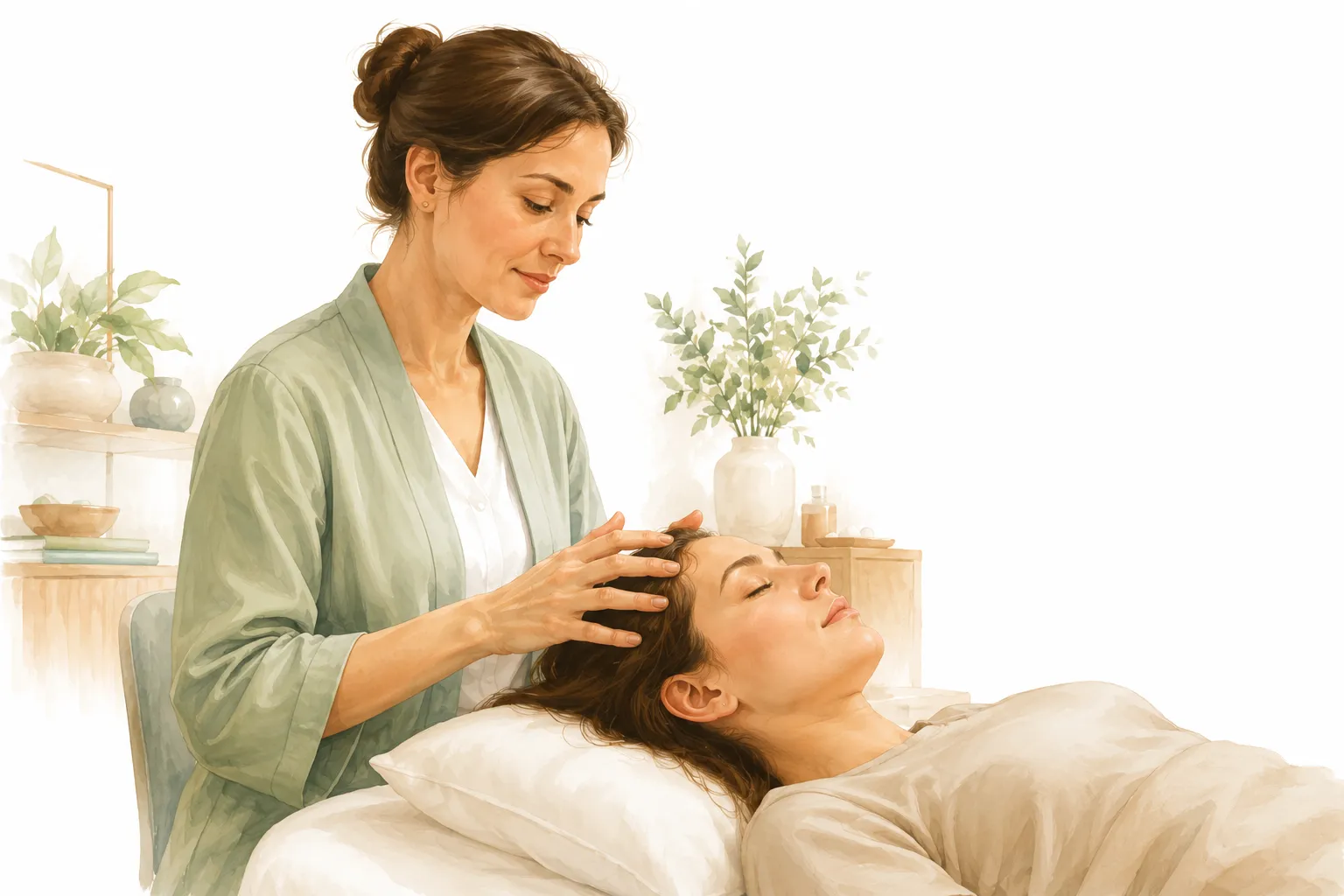
Two practices, different approaches
Reiki and Access Bars at a glance
Reiki and Access Bars are both often described as energy healing or complementary wellness practices. Both involve a practitioner working with a recipient who lies down and rests. Beyond these surface similarities, the practices differ significantly in their origins, techniques, and underlying philosophies.
Reiki is a Japanese practice developed by Mikao Usui. It involves channeling what practitioners call "universal life force energy" through the hands. The practitioner places their hands lightly on or just above the recipient's body, with the intention of promoting relaxation and energy balance[citation:14].
Access Bars was developed by Gary Douglas in 1990 as part of the Access Consciousness system. It involves gently touching 32 specific points on the recipient's head. According to practitioners, each point is associated with a different area of life—such as money, control, creativity, healing, and awareness—and touching them releases stored thoughts and emotions[citation:13][citation:14].
Both practices have passionate practitioners and recipients who report benefits. However, both also have limited independent scientific evidence to support their broader claims. Neither should be used as a substitute for professional medical care.
Reiki vs Access Bars: Side-by-side comparison
A visual comparison of Reiki and Access Bars across key dimensions.
Origins
Reiki: Japan; Access Bars: USA (1990).
Technique
Reiki: Hands on or above body; Access Bars: 32 head points.
Focus
Reiki: Energy flow and balance; Access Bars: Releasing limiting beliefs.
Training
Reiki: Attunements; Access Bars: One-day certification course.
Skim first
Key takeaways
The shortest useful version of this page.
Reiki originated in Japan and uses hands-on or hands-off energy work.
Access Bars originated in the USA in 1990 and uses gentle touch on 32 head points.
Reiki focuses on energy balance; Access Bars focuses on releasing limiting beliefs.
Both have limited scientific evidence.
Both are complementary wellness, not medical treatment.
Choose based on your preferences and keep expectations realistic.
Where Reiki and Access Bars came from
- Mikao Usui developed Reiki in Japan as a system of hands-on energy healing.Reiki spread globally and became one of the best-known energy healing practices.
- Gary Douglas developed Access Bars as part of the Access Consciousness system.Access Bars emerged as a distinct practice with its own technique and philosophy.
- Both practices have grown in popularity, particularly in wellness and complementary medicine circles.The differences between them have become more relevant as people choose between practices.
Reiki vs Access Bars: Key differences
The table below summarizes the main differences between Reiki and Access Bars.
Origin
Japan, developed by Mikao Usui
USA, developed by Gary Douglas in 1990[citation:13]
Technique
Hands placed lightly on or above the body
Gentle touch on 32 points on the head[citation:14]
Focus / Philosophy
Channeling universal life force energy ("Ki")
Releasing limiting thoughts, beliefs, and emotions[citation:13][citation:14]
Training
Typically requires attunements from a Reiki Master
One-day practitioner certification course[citation:12]
Touch required
Can be hands-on or hands-off
Hands-on gentle touch on the head[citation:1]
Part of a larger system
Reiki is a standalone practice
Part of Access Consciousness[citation:13]
Reported benefits
Relaxation, stress reduction, energy balance
Relaxation, mental clarity, emotional release[citation:13]
Evidence
Limited independent clinical evidence
Limited independent clinical evidence
Medical role
Complementary wellness, not medical treatment
Complementary wellness, not medical treatment
Reiki explained
What is Reiki and how does it work?
Reiki is a Japanese practice that involves channeling what practitioners call "universal life force energy" through the practitioner's hands[citation:14]. The word Reiki comes from two Japanese words: "Rei" meaning "God's Wisdom or the Higher Power" and "Ki" meaning "life force energy"[citation:8].
During a Reiki session, the recipient lies down fully clothed while the practitioner places their hands lightly on or just above the body. The practitioner does not manipulate muscles or tissue; the intention is to allow energy to flow to where it is needed.
Reiki practitioners describe the practice as a way to restore balance to the body's energy system. Some recipients report feeling warmth, tingling, or deep relaxation during a session[citation:14].
Reiki has been studied for various conditions, but the evidence is limited and often of low quality. Most research points to relaxation and stress reduction as the most plausible benefits.
Access Bars explained
What is Access Bars and how does it work?
Access Bars is a practice developed by Gary Douglas in 1990. It involves gently touching 32 specific points on the head. According to practitioners, these "Bars" store thoughts, emotions, and limiting beliefs related to different areas of life—such as money, control, creativity, healing, and awareness[citation:13][citation:14].
During an Access Bars session, the recipient lies down fully clothed while the practitioner gently touches or holds the 32 head points. The touch is light, not massage pressure. Practitioners describe this as "running the Bars."
According to Access Consciousness, the Bars hold "the electromagnetic component of all the thoughts, ideas, attitudes, decisions and beliefs that you have ever had about anything"[citation:1][citation:11]. Touching them is said to release or dissipate this stored charge.
Some people report relaxation, calmness, or mental clarity after a session. Others report no noticeable change. The broader claims about the Bars—such as releasing stored thoughts and emotions—are not scientifically established.
How practitioners describe the difference
- Practitioner
Reiki practitioners often describe their work as channeling life force energy to promote balance and healing. Access Bars practitioners describe their work as clearing limiting beliefs and mental clutter.
- Participant
Some recipients prefer Reiki for its gentle, full-body approach. Others prefer Access Bars for its focus on mental clarity and the head points.
- Balanced view
Both practices offer gentle, relaxing experiences that some people find beneficial. The differences in technique and philosophy may appeal to different people.
- Evidence view
Neither practice has strong independent scientific evidence for its broader claims. Both may provide relaxation and stress reduction.
Neither practice should be considered a substitute for professional medical or psychological care.
Evidence scan
What does the evidence say about Reiki and Access Bars?
The evidence question for both Reiki and Access Bars is whether they produce specific effects beyond relaxation, expectation, and attention.
Overall: not enough evidence
Unclear or mixed
Not clearly for or against
Both practices provide relaxation and stress reduction.
Participant reports support relaxation, but this is not specific to either practice.
Leans against
Points that do not support the claim
Reiki channels universal life force energy.
There is no established scientific evidence for the existence of "life force energy."
Access Bars releases stored thoughts and emotions.
This is a claim within the Access Consciousness system and lacks independent scientific verification.
Reality check
Common misunderstandings about Reiki and Access Bars
- Myth
Reiki and Access Bars are the same thing.
RealityThey have different origins, techniques, and philosophies. Reiki involves channeling energy; Access Bars involves touching specific head points[citation:14].
- Myth
Both are scientifically proven.
RealityNeither has strong independent scientific evidence for its broader claims.
- Myth
Reiki puts energy into you; Access Bars takes energy out.
RealityThis is a common practitioner description, but neither mechanism is scientifically established[citation:1][citation:8].
- Myth
You have to believe in them for them to work.
RealitySome people report benefits regardless of belief, but the broader claims are not established.
Safety
Are Reiki and Access Bars safe?
Both practices involve gentle touch and are generally low risk. The main risks are unrealistic expectations and delaying professional care.
Generally low-risk for
- Adults who understand the practices' limitations
- People comfortable with gentle touch
- Those who continue professional care
Use caution if
- You are in a mental health crisis
- You have serious health concerns and are considering replacing treatment
- A practitioner makes unrealistic claims
Seek professional help if
- You have persistent symptoms
- You need a diagnosis or treatment plan
- You are experiencing a mental health emergency
Reiki and Access Bars are complementary wellness practices, not substitutes for professional medical or psychological care.
What to remember about Reiki vs Access Bars
Reiki: Japanese, hands-on or hands-off energy work.
Access Bars: American, gentle touch on 32 head points.
Reiki: Focuses on channeling universal life force energy.
Access Bars: Focuses on releasing limiting thoughts and beliefs.
Both: Limited scientific evidence.
Both: Complementary wellness, not medical treatment.
Verdict
Our verdict: Reiki vs Access Bars
insufficient-evidence
Reiki and Access Bars are different complementary practices with different origins, techniques, and philosophies. Reiki involves channeling universal energy; Access Bars involves touching 32 head points to release limiting beliefs. Both may provide relaxation and stress reduction, but neither has strong independent scientific evidence for its broader claims. Neither should replace professional medical or psychological care.
What we know
- Reiki originated in Japan and involves hands-on or hands-off energy work.
- Access Bars originated in the USA in 1990 and involves touching 32 head points.
- Reiki focuses on energy flow and balance; Access Bars focuses on releasing limiting beliefs.
- Both practices are gentle and may help people relax.
What we do not know
- Whether Reiki channels "universal life force energy."
- Whether Access Bars stores or releases thoughts and emotions in specific head points.
- Whether either practice produces specific therapeutic benefits.
Try Reiki if you want a full-body energy balancing experience. Try Access Bars if you want a head-focused practice that claims to clear mental clutter. Try both if you are curious. But always continue professional care and keep expectations realistic.
Bottom line
Two paths, one question
Reiki and Access Bars are different practices with different approaches. Which one is right for you depends on what you are looking for. Both are gentle. Both are unproven. Both should be used as complementary wellness, not medical treatment.
Quick answers
Frequently asked questions
What is the difference between Reiki and Access Bars?
Reiki involves channeling universal energy; Access Bars involves touching 32 head points to release limiting beliefs[citation:14].
Which is more effective, Reiki or Access Bars?
Both have limited evidence. Effectiveness is subjective and depends on the individual.
Can Reiki and Access Bars be combined?
Yes, some practitioners offer both and some recipients combine them[citation:14].
Is Access Bars just Reiki on the head?
No. They are different practices with different origins, techniques, and philosophies[citation:14].
Which is better for anxiety?
Both may help some people relax, but neither is a proven treatment for anxiety.
Sources
REPLACE IF AVAILABLE. REPLACE WITH VERIFIED REIKI ORIGIN SOURCE. REPLACE WITH VERIFIED SOURCE, REPLACE_IF_AVAILABLE. Accessed YYYY-MM-DD
Use to establish Reiki's origins and key concepts.
REPLACE IF AVAILABLE. REPLACE WITH VERIFIED ACCESS CONSCIOUSNESS OFFICIAL PAGE. Access Consciousness, REPLACE_IF_AVAILABLE. Accessed YYYY-MM-DD
Use to establish the official description of Access Bars and Access Consciousness.
REPLACE IF AVAILABLE. REPLACE WITH VERIFIED COMPARATIVE ANALYSIS SOURCE. REPLACE WITH VERIFIED SOURCE, REPLACE_IF_AVAILABLE. Accessed YYYY-MM-DD
Use to provide a balanced comparison of the two practices.