The big picture
A self-development system built around "choice" and "possibility"
Access Consciousness describes itself as a set of practical tools for becoming more aware of the choices available in your life, and for releasing thoughts, beliefs, and judgments that limit what feels possible. It was founded by Gary Douglas, who has said the initial ideas — including the Access Bars points — came to him through channeling, including experiences he described as contact with the spirit of Grigori Rasputin.
Over time, the system grew to include Dr. Dain Heer as a major co-creator and public figure, along with a large catalog of classes, workshops, and licensed practitioner and facilitator certifications covering areas like relationships, money, the body, and specific "body processes" beyond the Bars.
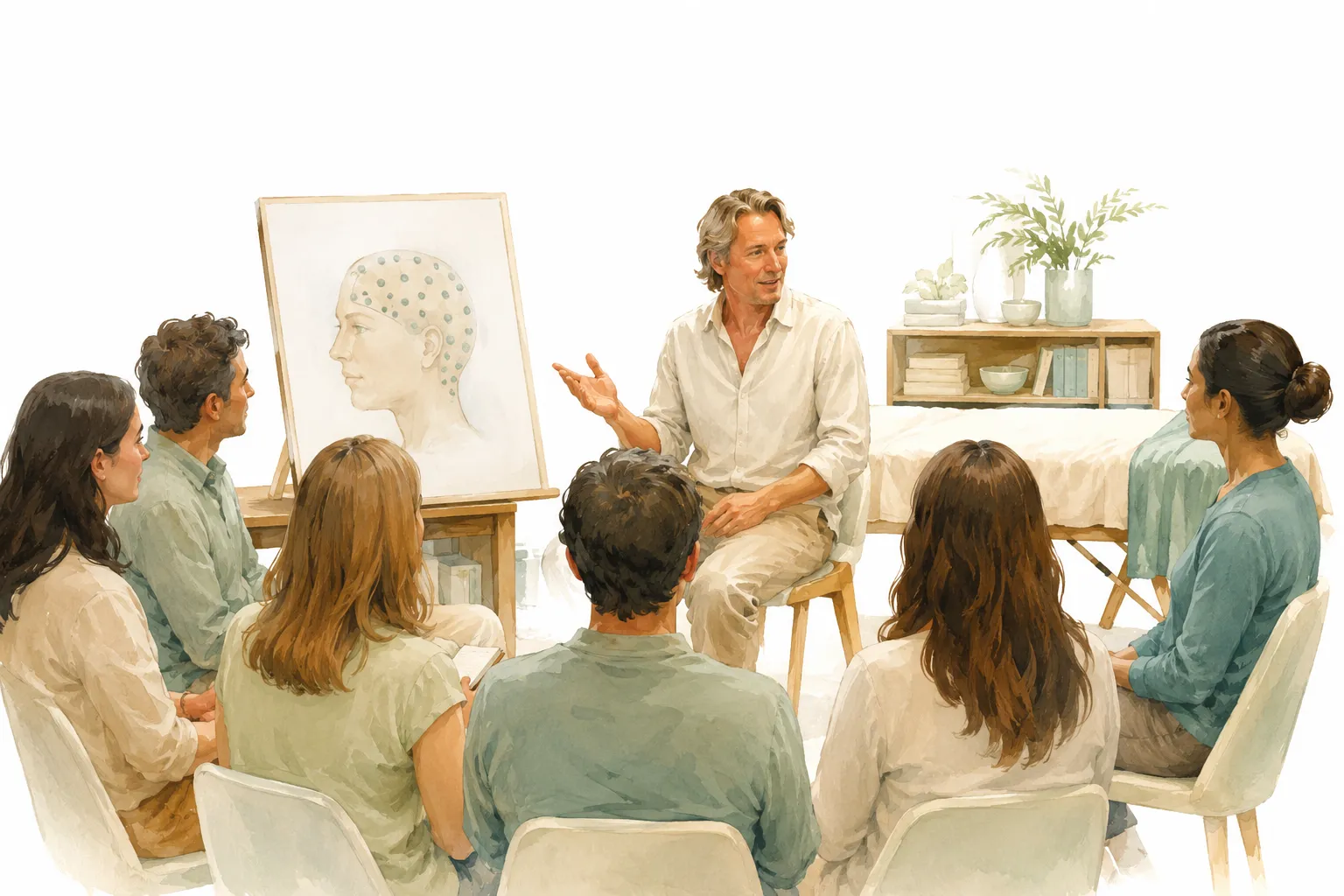
The core practical tools are fairly simple to describe. Access Bars is the hands-on technique — light touch on 32 head points. The Clearing Statement is a verbal process practitioners use, treated as a way to "clear" limiting points of view during conversation, using specific repeated phrasing.
Independent coverage of Access Consciousness has been considerably more skeptical than the organization's own materials. Journalists, scientists, and skeptic writers have compared the point system to phrenology, criticized the quality of research the organization cites, and reported on serious allegations — including claims of manipulative or cult-like group dynamics and misconduct allegations against some people connected to the organization's leadership, which have been the subject of independent reporting and legal proceedings in various jurisdictions.
Skim first
Key takeaways
The shortest useful version of this page.
Access Consciousness is a self-development system founded by Gary Douglas in the early 1990s.
Access Bars is its best-known technique, but only one part of a larger set of classes and tools.
The system's core claims about energy, consciousness, and channeling aren't supported by mainstream science.
Independent reporting has raised concerns about the organization beyond the scientific critique.
Trying a single Access Bars session doesn't require accepting the broader philosophy.
Origins
Gary Douglas and the founding of Access Consciousness
Gary Douglas founded Access Consciousness in the early 1990s. According to independent reporting, Douglas has described channeling various figures over the years, including a spirit he called "Raz," whom he identified as Grigori Rasputin, as well as other channeled entities. He has credited these experiences with the origin of some of the system's core ideas, including the Access Bars points.
Dr. Dain Heer later became a central co-creator, helping expand the organization's public materials, classes, and international reach before his death in 2022. Today, Access Consciousness operates as a global network of independently certified facilitators and practitioners.
The main ideas and tools
Choice, possibility, and "clearing"
Access Consciousness centers on the idea that most people are operating from fixed points of view, judgments, and past decisions that limit what feels available to them, and that specific tools can help "clear" that limitation.
In practice, the framework relies heavily on concepts — like stored "electromagnetic charge" or channeled knowledge — that don't correspond to recognized categories in physics, medicine, or psychology, even though the language sometimes borrows scientific-sounding terms.
The best-known tool
Where Access Bars fits into the wider system
Access Bars is Access Consciousness's most widely known and commercially successful offering, and for many people it's the only part of the organization they ever encounter — often through a single relaxation session or a one-day practitioner class taken purely out of curiosity.
It's worth knowing, though, that Access Bars is one entry point into a much larger catalog of Access Consciousness classes and philosophy. Some people who try a Bars session go no further; others move on to additional workshops covering money, relationships, or the body, which introduce more of the organization's broader worldview.
Evidence scan
What the evidence says about Access Consciousness's core claims
The organization's central claims about consciousness, energy, and "clearing" have drawn substantial independent scrutiny.
Overall: not supported by evidence
Leans in favor
Points that support the claim
Access Consciousness classes and Access Bars sessions are relaxing and enjoyable for many participants.
This is broadly consistent with participant reports and doesn't require accepting the organization's underlying claims about energy or channeling.
Leans against
Points that do not support the claim
Access Consciousness's tools are grounded in an established scientific understanding of consciousness or energy.
Independent physicians and science writers have found no basis for the organization's energy and consciousness claims in mainstream physics, neuroscience, or medicine, and have compared its head-point system to phrenology.
Reality check
Common misunderstandings
- Myth
Access Consciousness is just another name for Access Bars.
RealityAccess Bars is one technique within a much larger system of classes, tools, and philosophy.
- Myth
Access Consciousness is a recognized branch of psychology or energy medicine.
RealityIt's an independent, self-created system not affiliated with or validated by mainstream psychology, medicine, or physics.
- Myth
Trying a single Access Bars session means joining the wider organization.
RealityMany people try a session purely for relaxation and never engage with the broader philosophy or additional classes.
What to remember
Access Consciousness is a self-development system founded by Gary Douglas in the early 1990s.
Its best-known tool, Access Bars, is a light-touch head technique.
The system also includes verbal tools like the Clearing Statement and numerous other classes.
Its core claims about energy and consciousness aren't supported by mainstream science.
Independent reporting has raised serious concerns beyond the scientific critique, worth reviewing before deeper involvement.
Quick answers
Frequently asked questions
What does Access Consciousness teach?
That people carry limiting thoughts and judgments, and that specific tools — including Access Bars and verbal "clearing" techniques — can help release them.
Is Access Consciousness a religion?
No — it presents itself as a practical self-development system rather than an organized religion.
What is the Clearing Statement?
A verbal tool used in Access Consciousness, treated by practitioners as a way to process and release limiting points of view during conversation.
Has Access Consciousness been criticized?
Yes — by scientists over its unverified claims, and in independent reporting over broader concerns about the organization and some of its leadership.
Sources
Access Consciousness. Wikipedia. Accessed 2026-07-17
Background on the organization's founding, key figures, and documented controversies.
Harriet Hall, MD. Access Consciousness: A New Version of Phrenology?. Science-Based Medicine. Accessed 2026-07-17
Independent physician commentary on the founder's account and the scientific validity of the system's claims.
Rasputin, Phrenology, and Dark Allegations: The Madness of Access Consciousness. McGill University Office for Science and Society. Accessed 2026-07-17
Independent investigative commentary on the organization's founder, claims, and reported controversies.