The basic idea
A simple touch procedure wrapped in a much bigger belief system
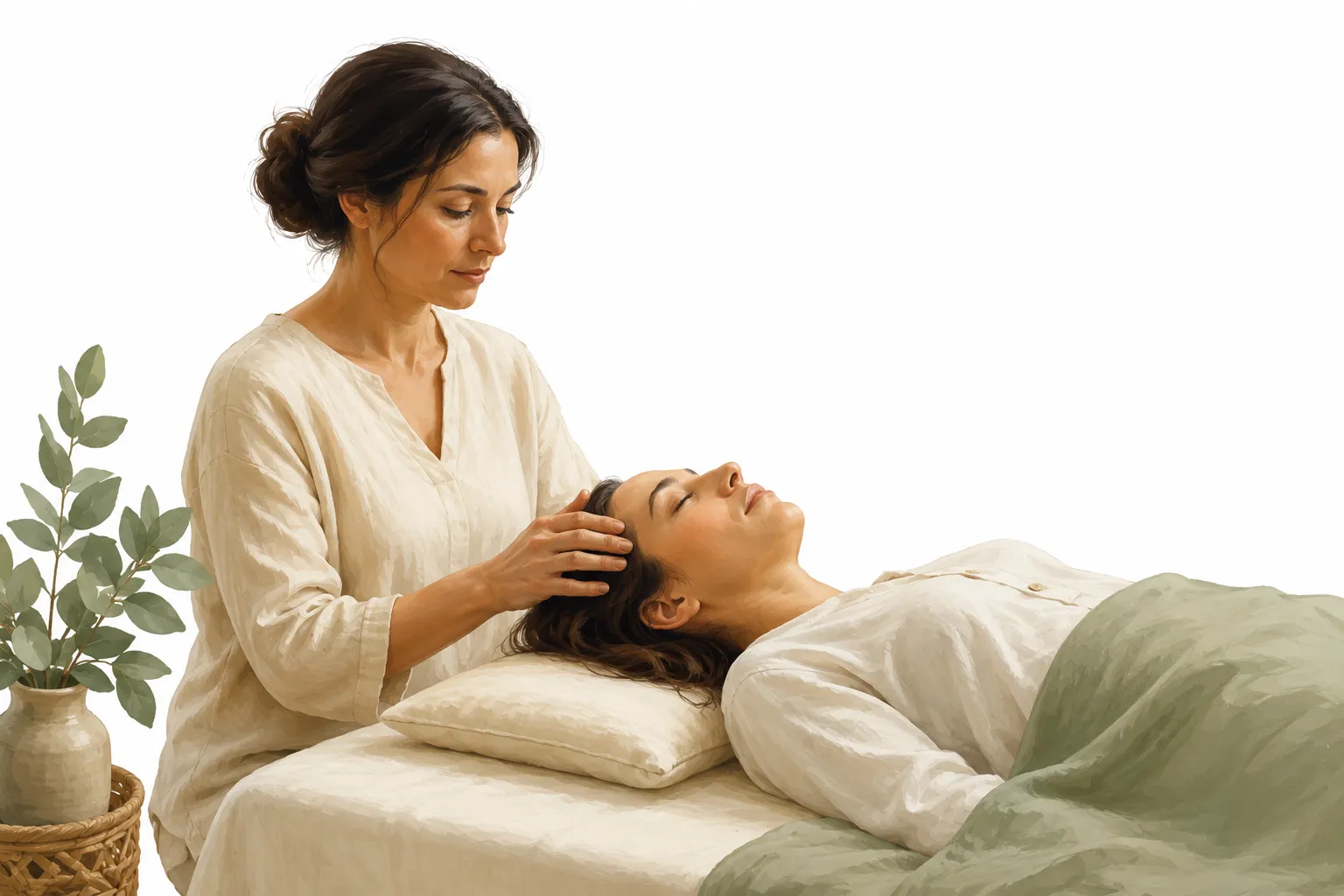
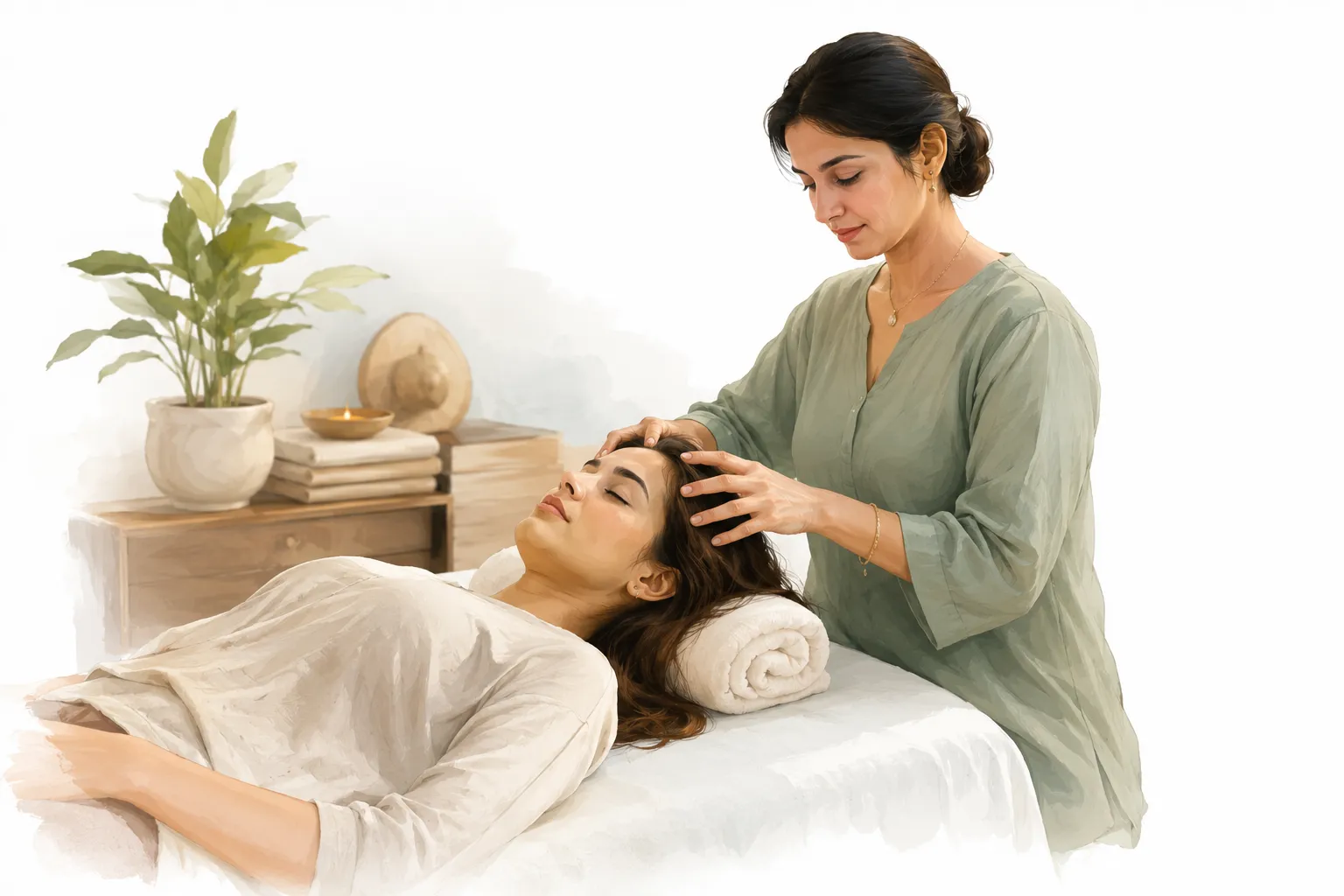
Strip away the terminology and Access Bars is straightforward: one person lies down, fully clothed, while another gently touches a sequence of points on their head. The touch is light, not a massage, and the recipient can talk, doze off, or simply lie still for the length of the appointment.
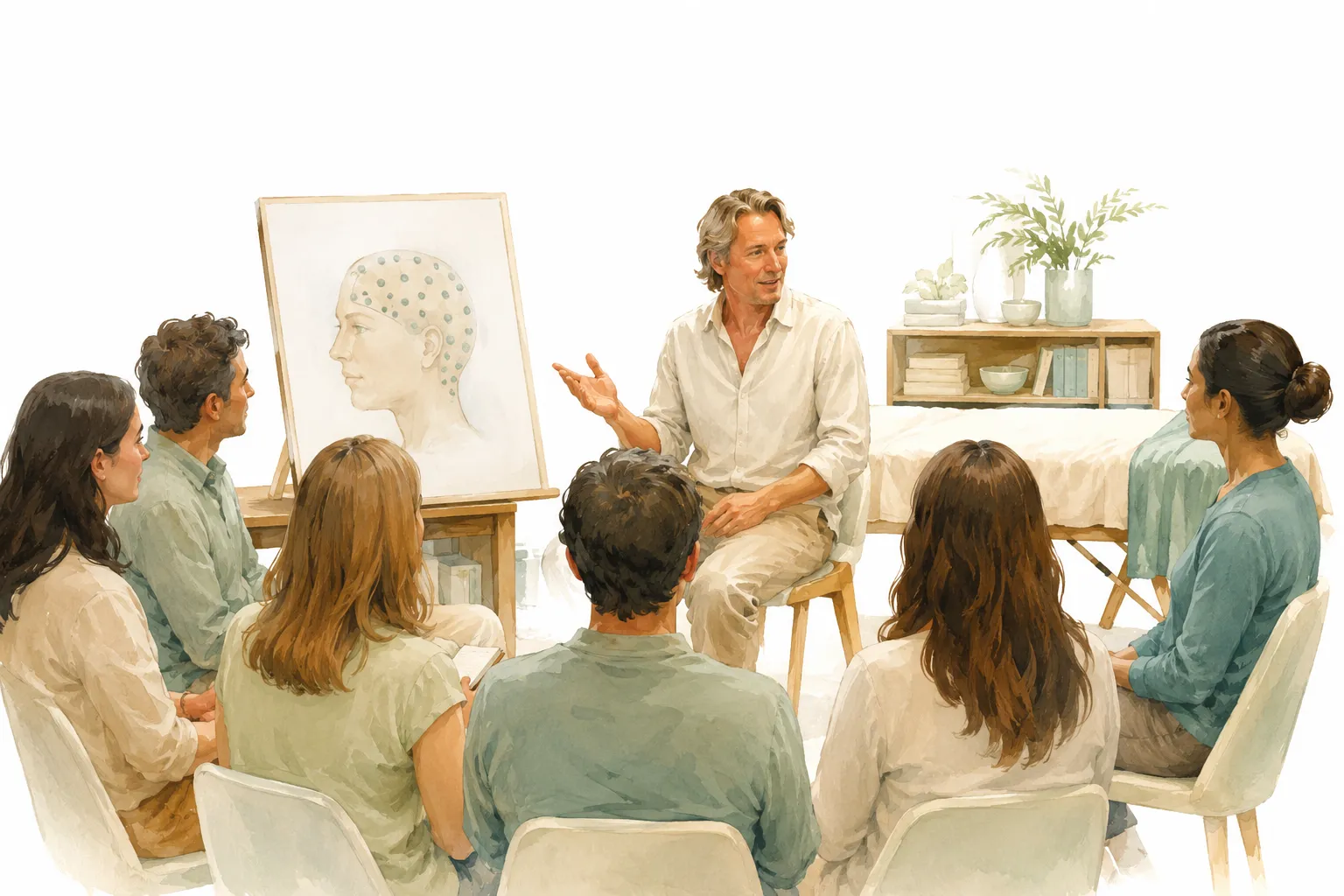
Access Bars was created by Gary Douglas within Access Consciousness, an organization he founded in Santa Barbara, California, in 1990. Douglas has said the points, called "Bars," were shown to him during channeling experiences. Access Consciousness materials describe the 32 points as storing the electromagnetic charge of thoughts, feelings, and decisions tied to specific themes such as money, control, creativity, and healing, and say that lightly touching them "runs" or releases that stored charge.
That explanation belongs to the Access Consciousness framework. It is not a description recognized in mainstream anatomy, neuroscience, or medicine. A person can feel genuinely calmer after lying still in a quiet room while someone attends to them gently, without that experience proving that specific beliefs about money or aging are physically stored under a particular patch of scalp.
The most useful way to think about Access Bars is to hold both things at once: the session itself is real and can feel pleasant, while the larger claims made about what it does deserve the same scrutiny given to any other unproven health claim.
How Access Bars is usually explained
A neutral map separating the visible session from the Access Consciousness point language and the current evidence boundary.
Resting setup
The client usually lies fully clothed in a quiet session setting.
Light contact
The practitioner uses gentle fingertip contact around the head rather than massage pressure.
Point language
Access Consciousness assigns life themes to the 32 Bars points.
Evidence boundary
The point meanings are system claims, not established anatomy or neuroscience.
Skim first
Key takeaways
The shortest useful version of this page.
Access Bars is a light-touch practice on 32 designated head points.
It was created by Gary Douglas within Access Consciousness in 1990.
Each point is assigned a claimed life theme.
Reported effects center on relaxation and calm.
Independent scientific support for the mechanism remains weak.
It is not a substitute for medical or mental-health care.
The procedure
What actually happens in an Access Bars session?
The recipient lies down fully clothed, usually on a massage or treatment table, while the practitioner sits near the head. Rather than kneading or applying pressure like a massage therapist, the practitioner rests fingertips lightly on combinations of the 32 points, moving through them in a sequence learned during training.
Sessions are often quiet, though some practitioners talk with the client throughout. People describe a range of sensations: warmth, tingling, heaviness, or nothing distinctive at all. Falling asleep during a session is common and is treated as a normal, even desirable, outcome rather than a sign that nothing is happening.
Nothing is ingested, injected, or physically manipulated. That makes the procedure easy to describe. The harder question, covered next, is what the touch is supposed to accomplish.
How is Access Bars supposed to work?
There are two explanations worth separating: the one offered inside Access Consciousness, and the ordinary effects of rest, attention, and touch that apply to many calm activities.
The practitioner locates the 32 points
Training teaches a fixed map of head locations, each linked to a life theme such as money, control, or aging.
Points are lightly held, often in combination
The practitioner rests fingertips on two or more points at once for varying lengths of time.
The system describes a release of stored charge
Access Consciousness materials say each point holds the "electromagnetic charge" of past thoughts and decisions, and that touch releases it.
Proponents sometimes compare it to defragmenting a cluttered hard drive.The recipient may feel calmer or notice nothing in particular
Reported experiences range from deep relaxation to no perceptible change.
The mechanism itself remains scientifically unverified
No recognized biological process has been shown to store personal beliefs at fixed scalp locations, and reviewers describe the model as resembling phrenology combined with energy-healing concepts rather than established neuroscience.
What are the 32 points?
Access Consciousness names the points after themes it says they govern. Materials from the organization and its practitioners commonly reference points including the following.
These names and meanings come from Access Consciousness teaching materials. They are not recognized anatomical structures, and touching them has not been shown to correspond to any verified biological function.

Money
Said to hold thoughts and decisions about finances.
A named point in the standard Bars map.
No evidence links financial beliefs to a specific head location.Control
Said to hold points of view about control.
A named point taught in Access Bars classes.
This is a system-internal claim, not an anatomical finding.Creativity
Said to hold beliefs limiting creative expression.
Commonly referenced in practitioner materials.
No verified mechanism connects touch here to creative ability.Healing
Said to relate to the body's capacity to heal itself.
Frequently cited as one of the core points.
Claims of enhanced self-healing are not supported by clinical evidence.Communication
Said to hold patterns around how a person communicates.
Regularly listed among the named points.
The stated association has not been independently verified.
Evidence scan
What does the evidence actually say?
The question is not whether people enjoy sessions. It's whether good research shows Access Bars produces effects beyond ordinary relaxation, attention, and expectation.
Overall: not enough evidence
Leans in favor
Points that support the claim
A single Access Bars session can reduce self-reported anxiety and depression symptoms.
A 2017 pilot study of seven participants found large drops in self-reported anxiety and depression scores after one 90-minute session, alongside changes in brain-wave measurements. The study had no control group, no comparison to rest or placebo touch, and a very small sample.
Leans against
Points that do not support the claim
Access Bars points correspond to a recognized energetic or anatomical system.
Reviewers describe the point map as resembling a mix of phrenology and energy-therapy concepts, with no demonstrated relationship to biology, neuroscience, or anatomy.
Access Bars is an effective treatment for medical or psychiatric conditions.
No large, controlled, independently replicated trials currently support this claim.
Reality check
Common misunderstandings
- Myth
Access Bars is a type of head massage.
RealityIt uses light, largely stationary contact rather than the kneading or pressure typical of massage.
- Myth
The 32 points are established acupressure or neurological points.
RealityThey are specific to the Access Consciousness system and are not part of recognized acupressure or medical anatomy.
- Myth
Feeling relaxed afterward proves the claimed mechanism is real.
RealityRelaxation can be genuine while the explanation offered for it remains unverified.
What to remember
Access Bars involves light touch on 32 points around the head.
It was created by Gary Douglas within Access Consciousness in 1990.
Each point is assigned a life theme, like money or creativity.
Some people report relaxation, calm, or better sleep afterward.
Independent, well-controlled evidence for the claimed mechanism is lacking.
It should not replace medical or psychological care.
Verdict
Our evidence-based verdict
insufficient-evidence
Access Bars is a structured light-touch relaxation practice. Some people find it calming, but its distinctive explanation and broader health claims are not currently backed by strong, independent scientific evidence.
What we know
- The technique uses light touch on 32 designated head points.
- It originated with Gary Douglas at Access Consciousness in 1990.
- Some participants report relaxation or improved mood afterward.
What we do not know
- Whether the named points correspond to any real physiological structure.
- Whether effects go beyond ordinary relaxation, attention, and expectation.
Treating a session as optional relaxation, rather than as proven treatment, keeps expectations realistic while leaving room to enjoy it if it feels good.
Quick answers
Frequently asked questions
What is Access Bars in one sentence?
It's a wellness session where a practitioner lightly touches 32 designated points on your head while you rest, fully clothed.
Who invented Access Bars?
Gary Douglas, founder of Access Consciousness, developed it in Santa Barbara, California, in 1990.
Does Access Bars hurt?
No. The touch used is described as light and gentle rather than the pressure used in deep-tissue massage.
Is Access Bars scientifically proven?
Not in a strong sense. Available research is limited to small, largely uncontrolled pilot studies.
What might I feel during a session?
Reports vary widely, from deep relaxation and sleepiness to tingling sensations or noticing little at all.
Sources
Access Consciousness. Wikipedia. Accessed 2026-07-14
Independent overview, history, and critical assessment of Access Consciousness and Access Bars.
Gary Douglas, Founder. Access Consciousness. Accessed 2026-07-14
Official biography of the founder, used for background on the organization.
Terrie Hope. The Effects of Access Bars on Anxiety and Depression: A Pilot Study. Energy Psychology: Theory, Research, and Treatment, 2017. Accessed 2026-07-14
Small, uncontrolled pilot study used to assess the current evidence base.