The point system explained
What are the 32 Access Bars points, and what are they supposed to do?
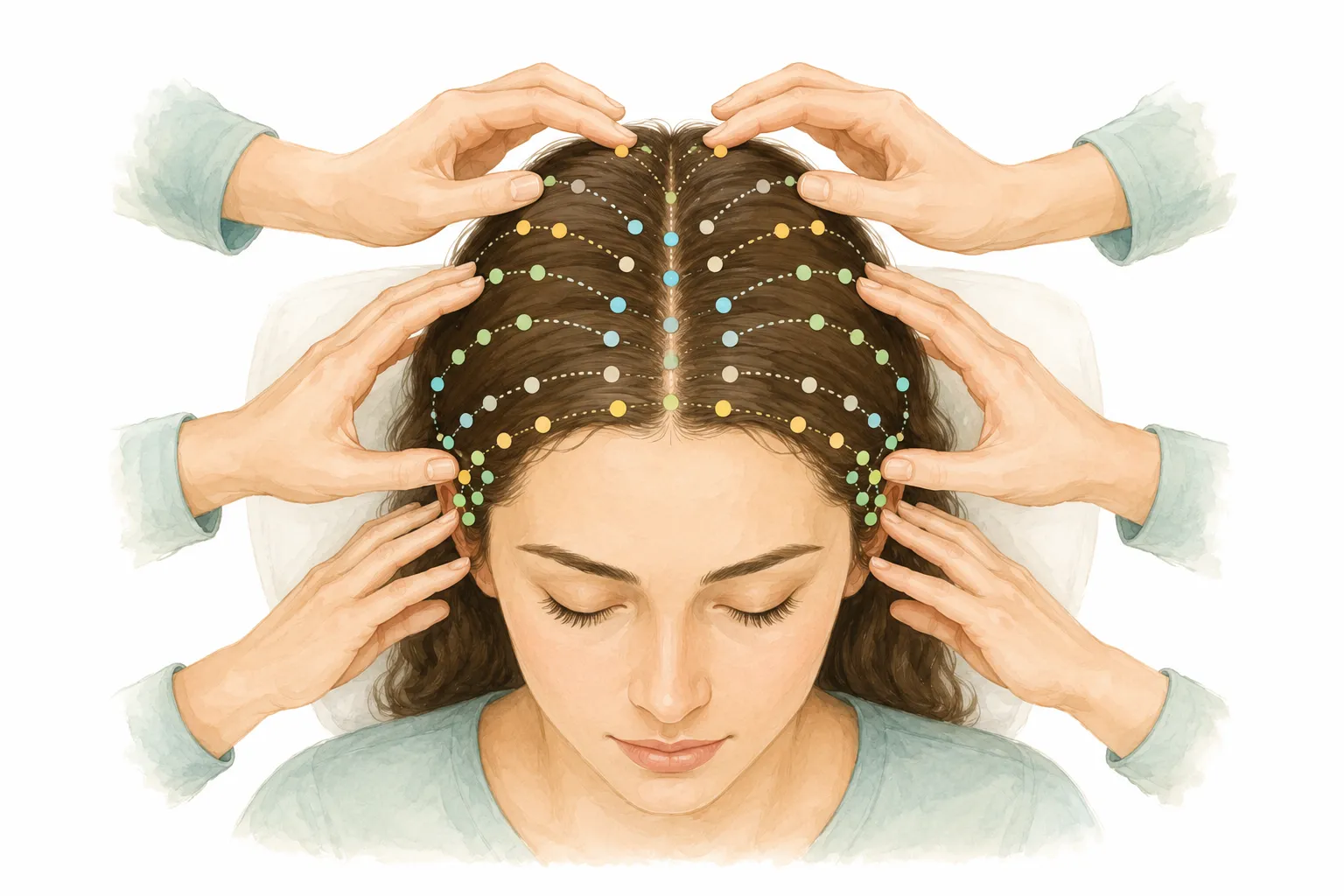
The 32 Access Bars points are the central feature of the Access Bars therapy method. These points are specific locations on the head that practitioners learn to identify and touch during sessions. According to Access Consciousness teachings, each point corresponds to a different aspect of a person's life.
Examples of these themes include healing, body, control, awareness, creativity, power, aging, sexuality, money, joy, and sadness [citation:3][citation:5][citation:10]. The points are said to store the "electromagnetic component" of thoughts, ideas, attitudes, decisions, and beliefs related to those themes [citation:10].
The word "bars" itself comes from the idea of "bars of energy" that run through and around the head [citation:10]. Touching these points is described as "running the bars": a process that practitioners claim releases accumulated energy and allows for positive change [citation:3].
It's important to emphasize that this is a philosophical and conceptual system, not a scientifically established anatomical model. The points are not recognized as biological structures by mainstream medicine or neuroscience. The claimed effects of touching them are not established by independent research.
What follows is a description of the point system as taught in Access Consciousness, with the understanding that the claims about what these points do are part of the system's teachings, not established scientific facts.
Skim first
Key takeaways
The shortest useful version of this page.
There are 32 Access Bars points on the head [citation:3][citation:12].
Each point is associated with a life theme, such as healing, control, creativity, or money [citation:3][citation:10].
The system claims the points store thoughts and emotions.
This claim is not scientifically established.
The points are a conceptual tool, not a biological reality.
They provide a consistent framework for the practice.
Relaxation is the most established outcome, not point-specific effects.
The 32 Access Bars points: locations and claimed meanings
The following is a list of the 32 Access Bars points and their claimed meanings, as taught in the Access Consciousness system. The exact names and sequence may vary slightly depending on the training source.
The names and meanings belong to the Access Bars system. They are not recognized as anatomical structures or scientifically validated treatment points. There is no established scientific evidence that specific life themes are stored at these locations.
1. Healing
Top of the head (approximate)
Physical, emotional, and mental healing
One of the primary points, said to relate to healing and well-being
No independent evidence supports the claimed association.2. Body
Side of the head (approximate)
Physical body and its well-being
Associated with the body and physical health
No evidence links this point specifically to body functions.3. Control
Side of the head (approximate)
Control-related thoughts and patterns
Said to relate to control in life situations
The claimed meaning is part of the system's philosophy.4. Awareness
Front of the head (approximate)
Self-awareness and consciousness
Associated with self-awareness and mindfulness
The claimed effect has not been scientifically validated.5. Creativity
Temple area (approximate)
Creativity and creative limitations
Said to influence creative expression
No evidence links this point specifically to creativity.6. Power
Temple area (approximate)
Personal power and influence
Associated with personal power and strength
The claimed mechanism remains unproven.7. Aging
Around the crown (approximate)
Physical aging and attitudes toward it
Said to relate to aging and how we experience it
No established evidence supports this claim.8. Sexuality
Base of the head (approximate)
Sexual energy and expression
Associated with sexual health and expression
The claimed association has not been scientifically established.9. Money
Top-sides of the head (approximate)
Financial thoughts and attitudes
Said to relate to money and financial beliefs
No established evidence links financial beliefs to this location.10. Communication
Sides of the head (approximate)
Communication patterns and beliefs
Associated with how we communicate
The claimed association has not been verified.11. Peace and Calm
Front of the head (approximate)
Inner peace and emotional calm
Said to promote peace and relaxation
Relaxation is a common report, but the point-specific effect is not established.12. Joy
Crown area (approximate)
Joy and happiness
Associated with feelings of joy
No evidence supports a specific effect on joy.13. Sadness
Top of the head (approximate)
Sadness and emotional release
Said to help release sadness
Emotional release is not scientifically established through this point.14. Hopefulness
Front of the head (approximate)
Hope and optimism
Associated with hope
No evidence supports this claim.15. Dreams
Top of the head (approximate)
Dreams and aspirations
Said to relate to personal dreams
The claimed association is not established.16. Gratitude
Side of the head (approximate)
Gratitude and appreciation
Associated with gratitude
No evidence supports this claim.17. Patience
Front of the head (approximate)
Patience and tolerance
Said to relate to patience
The claimed effect is not established.18. Forgiveness
Top of the head (approximate)
Forgiveness and release
Associated with forgiveness
No evidence supports this claim.19. Trust
Side of the head (approximate)
Trust and confidence
Said to relate to trust
The claimed association is not established.20. Safety
Base of the head (approximate)
Safety and security
Associated with feelings of safety
No evidence supports this claim.21. Abundance
Top of the head (approximate)
Abundance and prosperity
Said to relate to abundance
No evidence supports this claim.22. Love
Front of the head (approximate)
Love and relationships
Associated with love
No evidence supports a specific effect on love.23. Lightness
Top of the head (approximate)
Lightness and ease
Said to promote lightness
No evidence supports this claim.24. Softness
Side of the head (approximate)
Softness and gentleness
Associated with softness
No evidence supports this claim.25. Ease
Front of the head (approximate)
Ease and effortlessness
Said to relate to ease in life
No evidence supports this claim.26. Stillness
Top of the head (approximate)
Stillness and inner peace
Associated with stillness
No evidence supports this claim.27. Clarity
Front of the head (approximate)
Mental clarity and focus
Said to promote clarity
No evidence supports a specific effect on clarity.28. Creativity
Temple area (approximate)
Creative expression
Associated with creativity
No evidence links this point specifically to creativity.29. Body
Side of the head (approximate)
Physical body and health
Said to relate to the body
No evidence supports this claim.30. Control
Side of the head (approximate)
Control and power dynamics
Associated with control
The claimed meaning is part of the system's philosophy.31. Awareness
Front of the head (approximate)
Awareness and consciousness
Said to enhance awareness
No evidence supports this claim.32. Money
Top-sides of the head (approximate)
Money and financial abundance
Associated with money beliefs
No established evidence links financial beliefs to this location.
The Access Bars point system
The Access Bars point system
Within the Access Consciousness framework, the 32 points on the head are said to be "bars of energy" that store the electromagnetic charge of thoughts, emotions, beliefs, and decisions related to different areas of life.
The point system is the foundation of Access Bars therapy. Practitioners learn to identify these points and touch them in a specific sequence during sessions.
The points are used during Access Bars sessions to facilitate "release", though the mechanism is not scientifically established.
The point system is a conceptual map used within the Access Consciousness system. It provides a consistent framework for the practice. However, the points are not recognized as anatomical structures or scientific entities outside of this system.
How the 32 points are said to work, and what is established
There is the system's explanation and there is the scientific reality.
System's explanation: stored energy
Within Access Consciousness, the 32 points are said to store the "electromagnetic component" of thoughts, ideas, attitudes, decisions, and beliefs. Each point corresponds to a specific life theme [citation:10].
Like a set of labeled boxes, each containing different types of "stored" mental and emotional content.System's explanation: release through touch
Practitioners claim that gently touching these points dissipates the "electromagnetic charge" stored there, releasing the associated thoughts and emotions and allowing for positive change [citation:9][citation:10].
Like deleting files from a computer: the touch is said to "clear" the stored content.Scientific perspective: not established
There is no established scientific evidence that thoughts, emotions, or beliefs are stored in specific head points. The concept is not recognized in neuroscience or medicine. The point system is a philosophical framework, not a biological reality.
What actually happens: relaxation
What is established is that people who receive gentle touch in a quiet environment often feel relaxed. This relaxation can produce a sense of well-being, improved sleep, and reduced stress. But this does not prove that specific thoughts were "released" from specific points.
Reality check
Common myths about the 32 points
- Myth
The 32 points are recognized anatomical structures.
RealityThey are a conceptual framework used in Access Consciousness. They are not recognized by neuroscience or mainstream medicine.
- Myth
Each point has been scientifically proven to relate to the claimed theme.
RealityNo independent scientific evidence supports the claimed associations between points and life themes.
- Myth
Thoughts and emotions are literally stored in these points.
RealityThis is a claim from within the Access Consciousness system. There is no evidence that thoughts or emotions are stored in head points in this way.
- Myth
Touching the points has a distinct biological effect.
RealityWhile gentle touch can produce relaxation, there is no evidence that specific points produce specific effects beyond the general relaxation.
The 32 points: conceptual system vs. anatomical reality
Status of the points
32 "bars of energy" on the head
Not recognized as anatomical structures
What they store
Thoughts, emotions, beliefs, decisions [citation:10]
No evidence of such storage in these locations
Mechanism of effect
Release of "electromagnetic charge" through touch [citation:9][citation:10]
Gentle touch provides relaxation; no point-specific mechanism established
Scientific basis
Part of the Access Consciousness framework
Not supported by independent research
Proven outcomes
Claimed to release specific limitations
Relaxation is the most established outcome
What to remember about the 32 points
There are 32 Access Bars points on the head [citation:3][citation:12].
Each is said to correspond to a life theme: healing, control, creativity, money, aging, etc. [citation:3][citation:10].
The points are said to store the "electromagnetic charge" of thoughts and beliefs [citation:10].
Practitioners touch the points lightly in sequence during a session.
The point system is part of the Access Consciousness teaching framework.
The points are not recognized as anatomical or neurological structures.
No scientific evidence supports the claimed storage or release mechanism.
Relaxation is a common and reasonable outcome of the practice.
Verdict
Our verdict on the 32 points
not-supported
The 32 Access Bars points are a consistent and teachable conceptual system within the Access Consciousness framework. They provide a clear map for practitioners. However, the claims that these points store specific thoughts and emotions, or that touching them releases such content, are not scientifically established. The points are a conceptual tool, not a biological reality.
What we know
- The Access Bars system has 32 named points on the head.
- The points are associated with specific life themes.
- Practitioners touch them in a specific sequence.
- The system is taught consistently across training courses.
What we do not know
- Whether the points correspond to any biological structure.
- Whether thoughts and emotions are stored in the points.
- Whether touching specific points produces specific effects.
- Whether the claimed mechanism of "release" is real.
The 32 points are the structure of Access Bars therapy. They are a consistent and teachable map within the Access Consciousness system. But they are a conceptual map, not a scientifically verified reality. Approach them as part of the system's philosophy, not as established facts about how the brain or body works.
Bottom line
A consistent map, but not a scientific one
The 32 Access Bars points are the backbone of the practice. They provide a consistent structure for practitioners to learn and follow. But the claims attached to them (that they store thoughts and emotions, that touching them releases this content) are not established by evidence. The points are a useful framework for practicing Access Bars, but they are not a scientifically verified reality. Treat them as what they are: a conceptual system, not a biological one.
Quick answers
Frequently asked questions
What are the 32 points in Access Bars?
They are specific locations on the head, each said to correspond to a different aspect of life. Examples include healing, control, creativity, money, and aging [citation:3][citation:10].
Where are the Access Bars points located?
They are located around the head, on the top, sides, front, and base. The exact locations are taught in Access Bars training.
Do the Access Bars points really do what practitioners claim?
There is no scientific evidence that the points store or release thoughts and emotions in the way practitioners claim. The system is conceptual, not biological.
How many points are in Access Bars?
There are 32 points [citation:3][citation:12].
Sources
SoulAdvisor. Access Bars therapy description. SoulAdvisor. Accessed 2026-07-17
Description of the 32 points and their association with different life themes.
Access Bars . Pain & Health Solutions. Pain & Health Solutions, 2017-09-23. Accessed 2026-07-17
Description of the 32 "bars of energy" and their claimed effects on various life areas.
Sandy Page. Access Bars Practitioner description. Natural Therapy Pages. Accessed 2026-07-17
Description of the 32 points and the claimed mechanism of releasing stored thoughts and emotions.
Averina, S.. Access Bars: Освобождение от блоков (book). Yandex Books. Accessed 2026-07-17
Book describing the Access Bars point system and its claimed meanings.