
What a chart is for
A training tool, drawn from inside the practice
Most people encountering an Access Bars chart for the first time assume it must be based on some kind of established body map, the way an acupuncture chart is based on centuries of documented meridian theory or a reflexology chart maps the sole of the foot. Access Bars charts are different: they were produced within Access Consciousness specifically to teach the technique Gary Douglas developed, and they don't claim to rest on independent anatomical research.
A typical chart shows a head from the front, side, or top, with small markers indicating roughly where each of the 32 points sits, usually labeled with the paired theme names — Money, Control, Creativity, and so on. Because the points come in left-right pairs, most diagrams show matching dots on both sides of the head.
The value of the chart is practical: it gives students a consistent visual reference while they're learning where to place their hands and which combinations of points are commonly worked together. It is not, however, evidence that these specific zones are functionally distinct from surrounding areas of the scalp in any measurable physiological sense.
Reading a chart with that distinction in mind — a teaching aid rather than a clinical atlas — is the most accurate way to use one.
Reading a typical Access Bars chart
An example layout showing how the 32 points are commonly grouped for teaching purposes.
Front zone
Points nearer the hairline, often grouped with themes like creativity and communication.
Side zone
Points above and around the ears, often grouped with themes like control and money.
Crown zone
Points toward the top of the head, often grouped with themes like awareness and healing.
Back zone
Points toward the base of the skull, often grouped with themes like the body and aging.
Skim first
Key takeaways
The shortest useful version of this page.
An Access Bars chart shows the general layout of the 32 named, paired head points.
Charts are grouped into regions like front, side, crown, and back for teaching purposes.
They were produced within Access Consciousness, not independent anatomical research.
Minor variations exist between different training materials.
A detailed-looking chart doesn't prove the points are physiologically distinct.
Use a chart to understand the practice, not as a medical reference.
In practice
How practitioners actually use a points chart
During Access Bars training classes, instructors typically demonstrate hand placement directly on a person's head while students observe and then practice on each other, with a chart serving as a reference rather than a strict rulebook.
Because the points sit in symmetrical pairs, most practitioners describe learning them by feel and repetition rather than by measuring exact distances, and a chart mainly helps orient a beginner to the general regions before muscle memory takes over.
Once trained, most practitioners rely on trained touch and client conversation more than on consulting a printed chart during an actual session.
How the 32 points are commonly grouped on a chart
Charts typically cluster the points by general head region to make them easier to teach and remember.
These groupings reflect how Access Consciousness training materials commonly present the points for teaching purposes, not an independently verified anatomical classification.
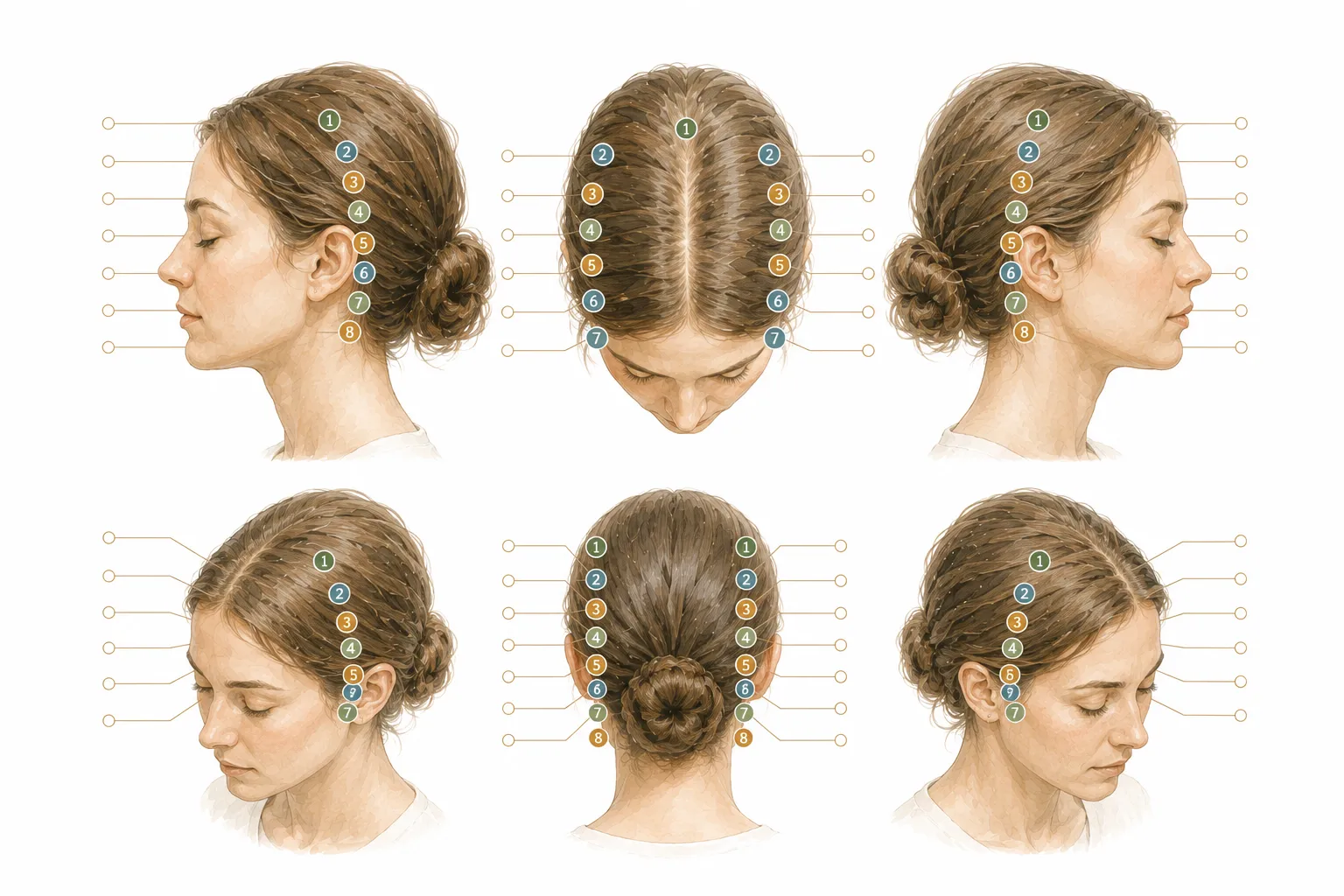
Front pairs
Near the hairline
Often associated with creativity and communication themes.
Commonly the first points introduced in beginner training.
Regional grouping is a teaching convenience, not a confirmed physiological distinction.Side pairs
Above and around the ears
Often associated with control and money themes.
Frequently touched in combination during a session.
No independent study confirms functional differences between these zones.Crown pairs
Top of the head
Often associated with awareness and healing themes.
Described in some materials as especially significant points to hold.
The significance described is internal to the system's teaching, not externally measured.Back pairs
Toward the base of the skull
Often associated with the body and aging themes.
Typically among the last points addressed in a session.
No verified anatomical basis links this region specifically to these themes.
Reality check
Common misunderstandings about the chart
- Myth
The chart is based on peer-reviewed anatomical research.
RealityIt was produced within Access Consciousness to teach the technique, not derived from independent anatomical studies.
- Myth
Every practitioner's chart shows the exact same coordinates.
RealityMinor variations exist between training materials and illustrators; the general regions stay consistent, but precise placement is not standardized to a clinical degree.
- Myth
A detailed-looking diagram proves the points are physiologically distinct.
RealityVisual detail reflects illustration choices, not independent scientific verification.
An Access Bars chart compared with a medical anatomical atlas
It helps to see the two side by side rather than assume they carry the same authority.
Origin
Produced within Access Consciousness training
Produced through anatomical dissection and peer-reviewed research
Verification
Internal to the practice
Independently replicated across institutions
Purpose
Teach hand placement for a wellness technique
Document confirmed body structures
Claim strength
Describes a taught practice
Describes a verified physical structure
What to remember
Charts show general zones for the 32 paired points, grouped by head region.
They exist to help students learn hand placement during training.
The charts were produced within Access Consciousness, not independent anatomy research.
Minor variations in placement exist between different training materials.
A detailed chart doesn't prove the points are physiologically distinct locations.
Verdict
Our evidence-based verdict
insufficient-evidence
An Access Bars chart is a useful, consistently taught training illustration for learning the technique's hand placements. It is not an independently verified anatomical or neurological map, and its precision should be understood as instructional rather than clinical.
What we know
- Charts consistently show 32 points in symmetrical pairs, grouped by head region.
- They are used primarily to train practitioners in hand placement.
- The charts originate within Access Consciousness training materials.
What we do not know
- Whether the marked zones correspond to any distinct physiological structure.
- Whether exact placement matters as precisely as a chart implies.
Treat a points chart as a helpful guide to how the technique is taught, not as proof of an underlying anatomical system.
Bottom line
A map of a method, not of the brain
The chart tells you how Access Bars is taught and practiced. It doesn't, on its own, tell you anything new about human anatomy or neuroscience.
Quick answers
Frequently asked questions
What does an Access Bars chart show?
It shows the general placement of the 32 named, paired head points used in the Access Bars technique.
Is the chart scientifically verified?
No. It's a training illustration produced within Access Consciousness rather than an independently verified anatomical map.
Why are the points shown in pairs?
Access Bars points are taught as symmetrical left-right pairs, and charts typically reflect that structure.
Do practitioners use the same chart during training?
Most training draws on similar reference materials, though exact illustrations can vary slightly between sources.
Can a chart replace hands-on training?
No. Most practitioners learn precise placement through supervised practice rather than from a diagram alone.
Sources
Access Bars: A Life-Changing Holistic Technique. Access Possibilities. Accessed 2026-07-17
Used to confirm general description of point pairs and session structure.
REPLACE WITH VERIFIED OFFICIAL ACCESS CONSCIOUSNESS CHART SOURCE. Access Consciousness. Accessed 2026-07-17
Use for the organization's own published chart or diagram, if available.