Where the number 32 comes from
A taught map, not a medical chart
When people search for "the 32 Access Bars points," they're usually trying to find out whether this is a real anatomical map or something closer to folklore dressed up in wellness language. The honest answer sits in between: the points are real in the sense that practitioners are trained to touch specific, repeatable locations on the head, but the names and meanings attached to those locations come entirely from within the Access Consciousness system.
Gary Douglas, who developed Access Consciousness, described the Bars as 32 points that run through and around the head, each corresponding to a particular area of life — money, creativity, control, healing, and so on. According to the system, every significant thought, decision, or belief you've ever held about that topic leaves behind an "electromagnetic" trace at the matching point. Touching the point is said to release that trace.
That explanation is internally consistent, but it isn't the same thing as a scientific finding. No peer-reviewed anatomy or neuroscience recognizes these 32 locations as functionally distinct from the rest of the scalp, and no independent research has measured or confirmed the proposed "electromagnetic" storage mechanism. That doesn't necessarily make the session pointless — plenty of people report feeling calmer afterward — but it does mean the point names should be read as the vocabulary of a specific practice, not as an established fact about the brain.
The rest of this guide lists the named points as they're commonly taught, explains what each is claimed to represent, and flags where the evidence simply isn't there yet.
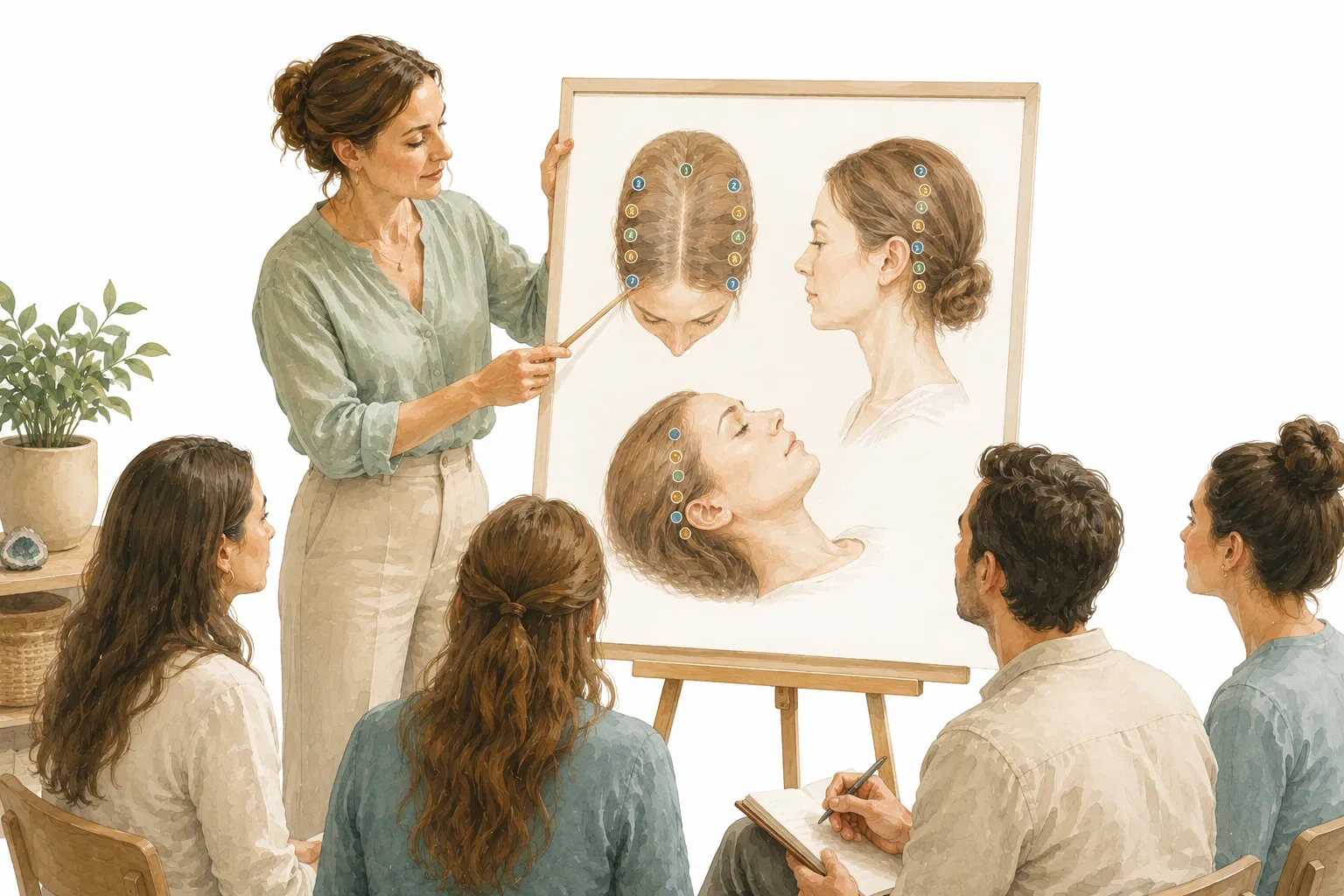
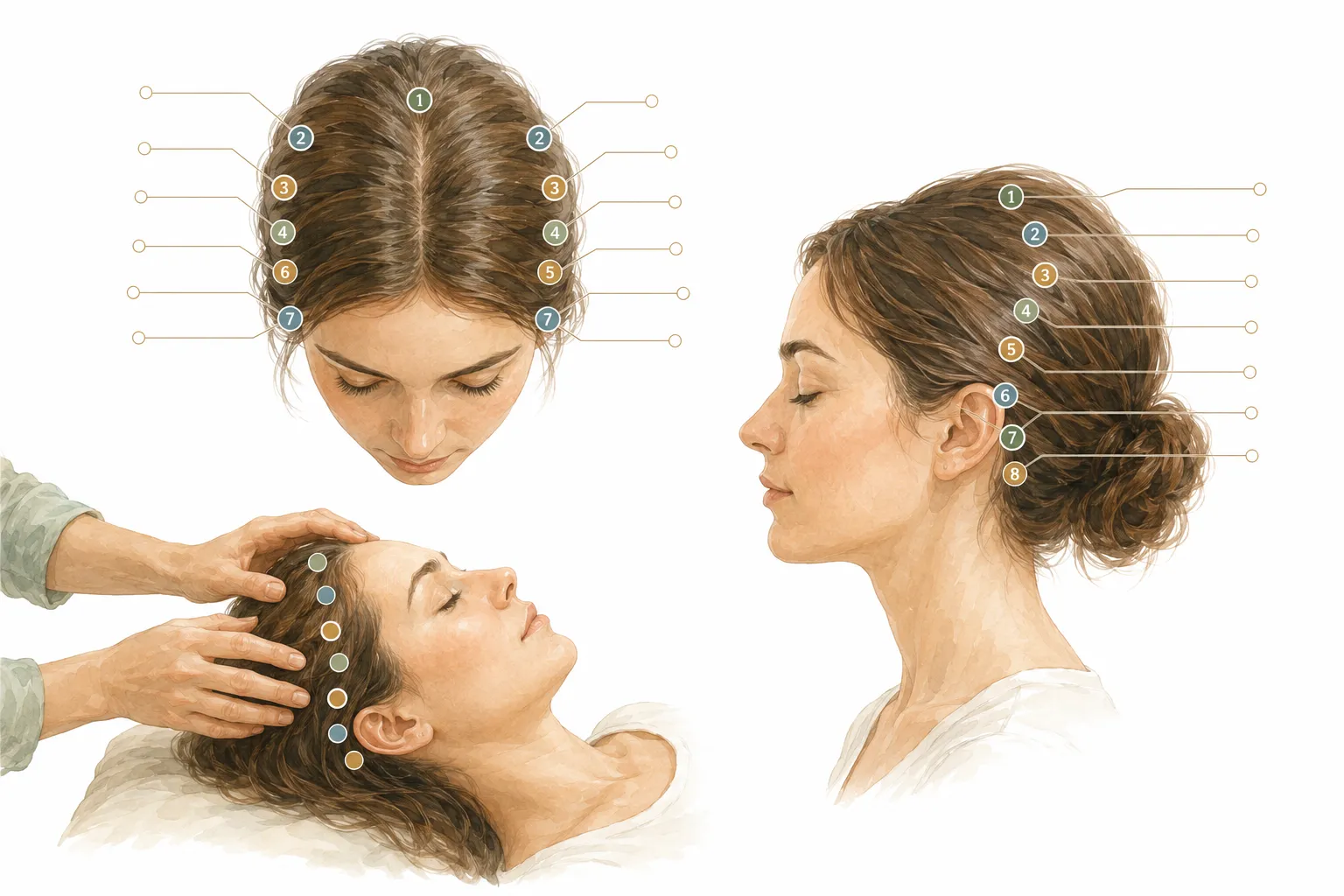
A generalized layout of the Bars
A neutral visual showing roughly how the named points are distributed across the head, without claiming precise medical coordinates.
Front pairs
Points nearer the hairline, commonly associated with themes like creativity and communication.
Side pairs
Points above the ears, commonly associated with themes like control and money.
Crown pairs
Points toward the top of the head, commonly associated with themes like awareness and healing.
Back pairs
Points toward the back of the head, commonly associated with themes like the body and aging.
Skim first
Key takeaways
The shortest useful version of this page.
Access Bars uses 32 named points arranged in symmetrical pairs on the head.
Common named points include Money, Control, Creativity, Awareness, and Healing.
The names and their claimed meanings come from within Access Consciousness.
No independent research confirms these as distinct anatomical or neurological locations.
Sessions vary in which points and combinations are used.
Reported relaxation doesn't confirm the underlying storage explanation.
Treat the point list as descriptive vocabulary, not a medical chart.
Sourcing
Where does the list of 32 points come from?
Every list of named Bars in circulation traces back to Access Consciousness training materials and the organization's own descriptions of the technique, first taught by Gary Douglas.
Different practitioners and Access Consciousness-affiliated sources sometimes phrase the theme names slightly differently — "aging" versus "getting older," for instance — but the core set of themes stays fairly consistent across sources: money, control, creativity, aging, sexuality, the body, joy, sadness, peace, time, space, awareness, kindness, gratitude, communication, and healing, among others, with each theme corresponding to a left-right pair of points.
Because the naming and meaning originate entirely inside one wellness system, this guide presents them as a description of what practitioners are taught — not as an independently confirmed anatomical inventory.
The named Access Bars points
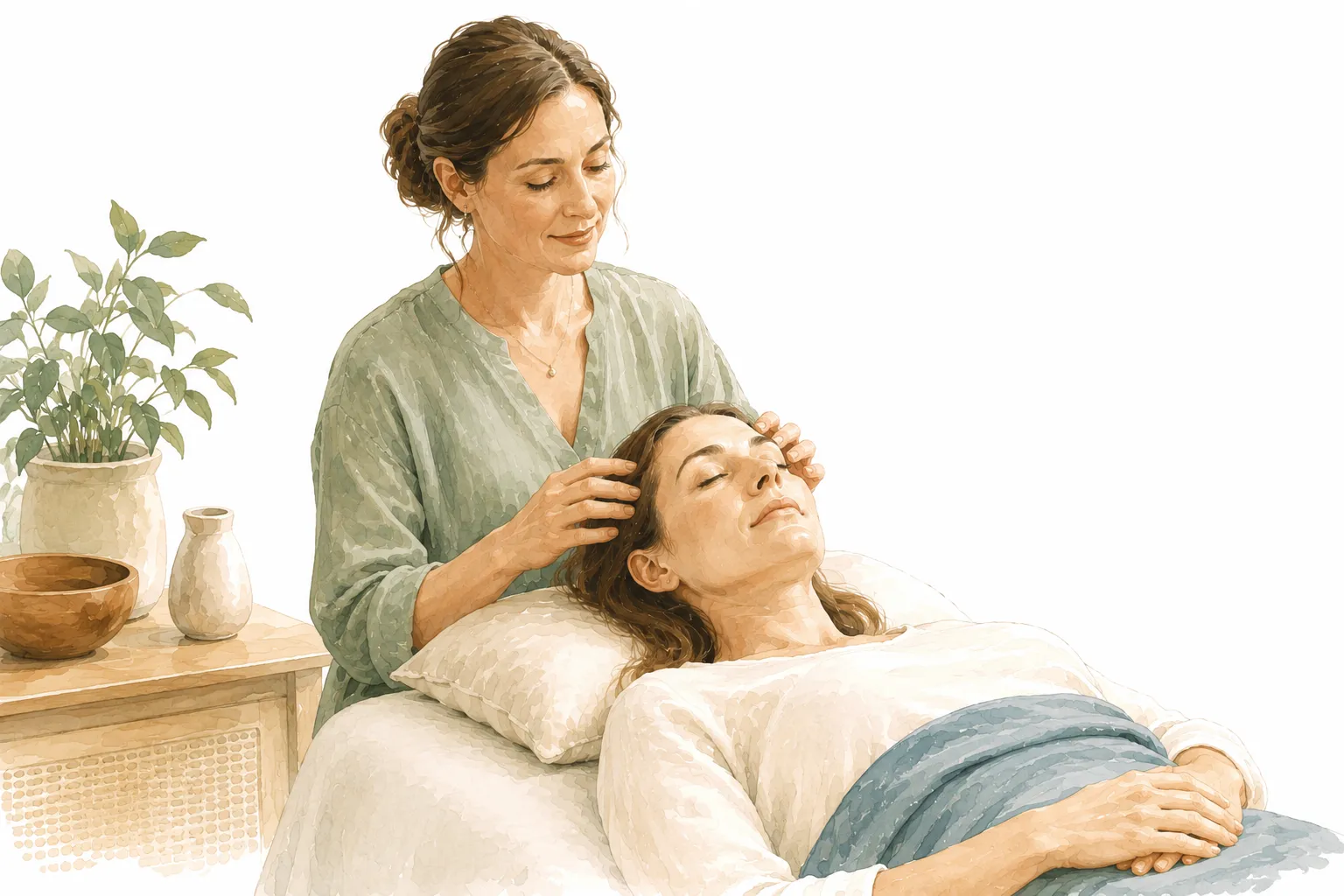
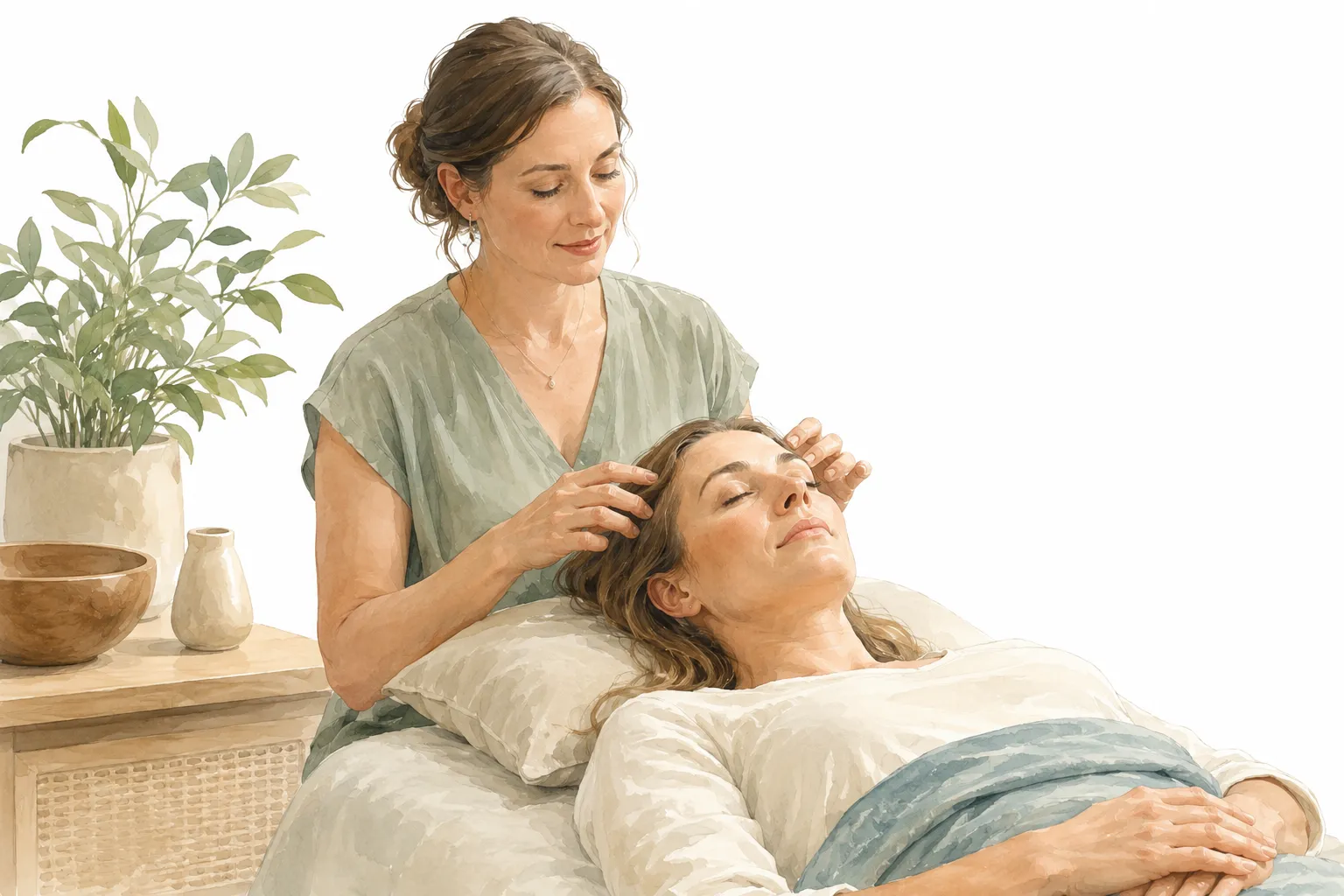
Below are the most commonly cited named points. Practitioners typically touch two or more at a time in a session rather than working through them as an isolated checklist.
These names and meanings are part of the Access Bars training system. They are not recognized anatomical structures and should not be treated as medical or diagnostic terms.
Money
Said to hold thoughts, decisions, and beliefs about money and financial security.
One of the most frequently mentioned points in Access Bars materials.
No independent evidence links this location to financial cognition or behavior.Control
Said to hold beliefs and patterns around control and being controlled.
Commonly paired with nearby points during a session.
The theme is a system-specific label rather than a verified psychological construct tied to a head location.Creativity
Said to hold blocks and beliefs related to creative expression.
Frequently referenced in introductory Access Bars descriptions.
No established neuroscience links creativity to this specific point.Aging
Said to hold beliefs and fears about growing older.
One of the life-stage themes included in most point lists.
There is no verified biological connection between this point and the aging process.Sexuality
Said to hold beliefs, judgments, and experiences related to sexuality.
Listed among the core themes in Access Consciousness materials.
The claimed storage mechanism has not been scientifically confirmed.Body
Said to hold beliefs about the physical body and its limitations.
Often described as closely linked to physical relaxation during a session.
Reported physical relaxation does not confirm the specific storage claim.Joy and sadness
Said to hold emotional patterns tied to happiness and grief.
Frequently mentioned as a pair in introductory materials.
Emotional shifts during a session are not proof of point-specific storage.Peace
Said to hold beliefs and blocks around inner peace.
Commonly included among the "state of being" themes.
No independent studies isolate this point's effect from general relaxation.Time and space
Said to hold beliefs about time pressure and personal space.
Often grouped together in point lists.
The claim is internal to the system's vocabulary rather than externally verified.Awareness
Said to hold blocks to perceiving and knowing.
Frequently described as central to the broader Access Consciousness philosophy.
See the dedicated Awareness Bar article for a closer look at this specific point.Kindness and gratitude
Said to hold patterns around giving and receiving appreciation.
Listed among the relational themes in most point charts.
No independent evidence ties this location to these traits.Communication
Said to hold beliefs and blocks around expressing yourself.
Commonly cited alongside creativity in introductory guides.
The claim reflects system terminology rather than confirmed neuroscience.Healing
Said to hold beliefs and judgments about healing and being healed.
Often described as one of the more emotionally significant points to touch.
See the dedicated Healing Bar article for more detail on this specific point.
How is touching a point supposed to help?
The explanation has two very different layers: what Access Consciousness teaches, and what can currently be measured.
A point is chosen based on the recipient's situation
Practitioners may ask about a person's current concerns and select combinations of points accordingly, though many sessions simply move through most or all of the points regardless.
The point is lightly held
Fingertip contact is sustained on one or more points for some period during the session.
The system proposes a release of stored charge
Access Consciousness materials describe this contact as releasing the electromagnetic charge of stored thoughts and beliefs tied to that theme.
Supporters sometimes compare it to clearing a stuck file so a computer can run more smoothly.The recipient may notice a subjective shift
People report anything from deep relaxation to no noticeable change at all.
The proposed mechanism remains unverified
No independent research has confirmed that specific thoughts are stored at these locations or that touching them produces a measurable release of anything beyond ordinary relaxation responses.
Reality check
Common misunderstandings about the 32 points
- Myth
The 32 points are recognized acupressure or meridian points.
RealityThey are a system-specific map developed within Access Consciousness, not a recognized acupressure or meridian chart, though some descriptions loosely compare them to meridian points.
- Myth
Each point stores memories the way a hard drive stores files.
RealityThat's a metaphor used to explain the concept, not a demonstrated biological process.
- Myth
A practitioner must touch all 32 points for the session to work.
RealityPractices vary; many sessions involve combinations of points rather than a fixed full sequence.
- Myth
Naming a point after a life theme proves the point affects that theme.
RealityThe name reflects the system's internal framework, not an established causal link.
What to remember
There are 32 points, arranged in symmetrical pairs across the head.
Each pair is given a name tied to a life theme, such as Money or Creativity.
The names and meanings come from within the Access Consciousness system.
No independent research confirms these as distinct anatomical or neurological structures.
Reported relaxation after a session doesn't confirm the underlying explanation.
Treat the list as a description of a practice's vocabulary, not a medical chart.
Verdict
Our evidence-based verdict
insufficient-evidence
The 32 named points are a consistent, learnable part of the Access Bars technique, and practitioners can reliably describe and locate them. Their claimed meanings and the proposed "electromagnetic" mechanism, however, remain internal to the Access Consciousness system and are not confirmed by independent science.
What we know
- Access Consciousness teaches 32 named, paired head points as part of Access Bars.
- Each named point is tied to a specific life theme.
- Practitioners are trained to touch combinations of these points during a session.
What we do not know
- Whether these points correspond to any distinct anatomical or neurological structure.
- Whether touching a named point produces effects specific to its claimed theme.
Use the point names to understand what a practitioner is doing and why they describe it that way, not as a verified map of where your thoughts are physically stored.
Bottom line
A vocabulary, not a verdict
The 32 points give Access Bars its structure and language. Understanding them helps you follow what a practitioner is doing, but it shouldn't be mistaken for proof of the deeper claims attached to each name.
Quick answers
Frequently asked questions
What are the 32 Access Bars points?
They are paired locations on the head, each given a name tied to a life theme such as Money, Creativity, or Healing, taught as part of the Access Bars technique.
Who decided there should be 32 points?
The number and names come from Gary Douglas, who developed Access Consciousness and the Access Bars technique.
Do practitioners touch every point in a session?
Not necessarily. Many sessions move through most points, while others focus on specific combinations depending on the recipient.
Is there scientific proof that these points store thoughts?
No independent, peer-reviewed research currently confirms that specific thoughts or beliefs are stored at these head locations.
Are the point names the same everywhere?
The core set of themes is fairly consistent across Access Consciousness training materials, though exact wording can vary slightly between sources.
Can I look up a chart of the points myself?
Access Consciousness-affiliated materials publish general descriptions, though independent anatomical charts of these exact points do not exist.
Sources
Access Bars: A Life-Changing Holistic Technique. Access Possibilities. Accessed 2026-07-17
Used to confirm commonly cited named points and general session description.
REPLACE WITH VERIFIED OFFICIAL ACCESS CONSCIOUSNESS POINTS DESCRIPTION. Access Consciousness. Accessed 2026-07-17
Use for the organization's own description of the point names and meanings.
REPLACE WITH VERIFIED RESEARCH ON ACCESS BARS MECHANISM. REPLACE WITH VERIFIED JOURNAL. Accessed 2026-07-17
Use to assess any independent research on the claimed storage mechanism.