Sorting the claims
Separating what people feel from what's been proven
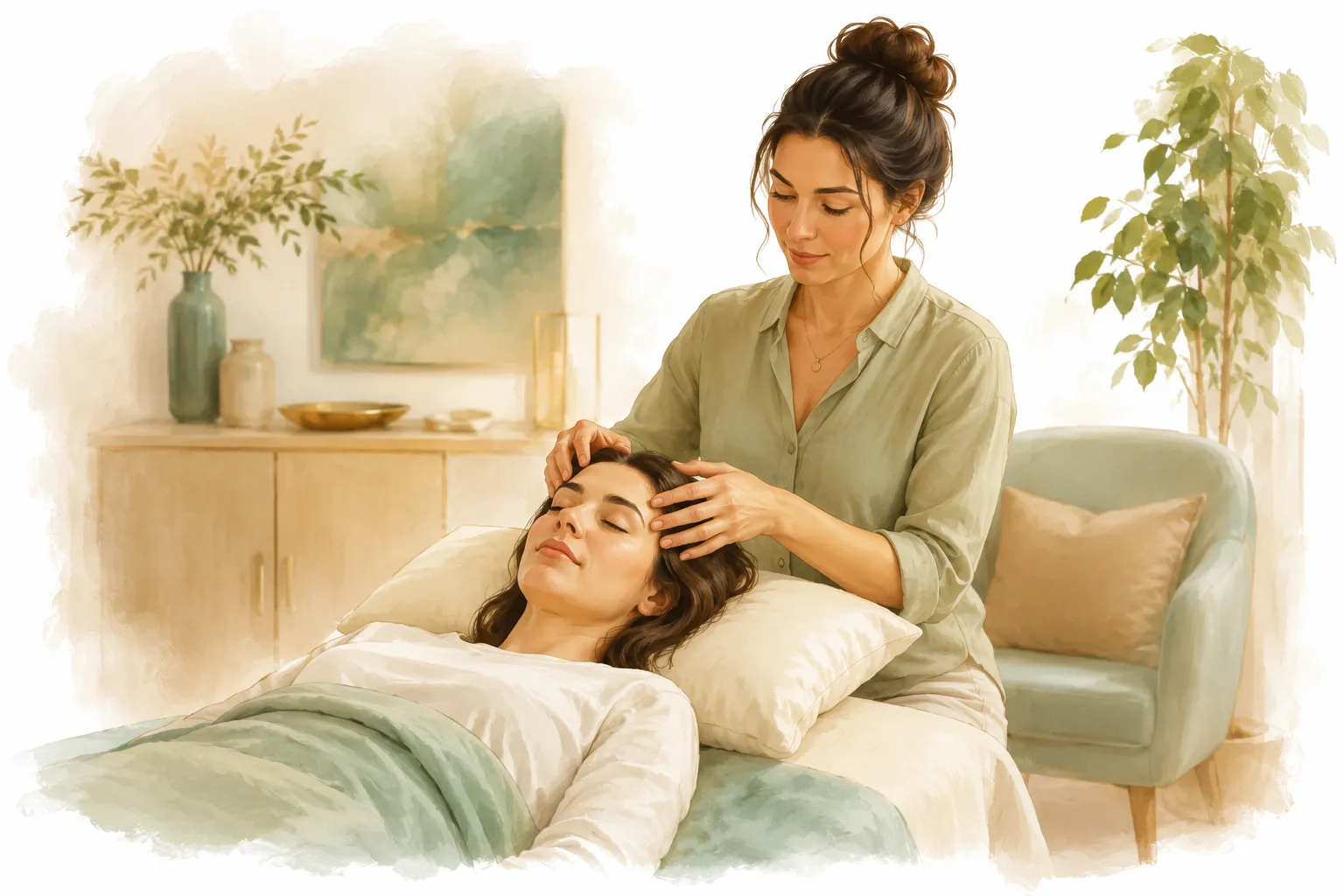
When you look at why people actually book Access Bars sessions, the reasons cluster around a few themes: general stress, trouble winding down, a sense of mental "noise," and curiosity after hearing a friend's positive experience. Those are modest, plausible reasons to try an hour of quiet rest with gentle touch.
The marketing language goes further. Access Consciousness materials and many practitioner websites describe the Bars as helping with anxiety, depression, sleep, focus, creativity, relationships, and even financial "blocks" — essentially, anything a person might want to change about their life. That breadth is itself worth noticing: a technique claimed to help with almost everything is harder to test rigorously than one aimed at a specific, measurable outcome.
Some benefits are more plausible than others. Relaxation from lying still in a quiet room while receiving calm, attentive touch is a well-understood effect, seen across many hands-on and mindfulness-adjacent practices. Claims about releasing decades-old beliefs through touching specific head points, or about improving financial outcomes, rest on the Access Consciousness framework itself rather than independent verification.
The practical approach is to weigh each claimed benefit on its own, rather than accepting the full list because one part of it — feeling calmer after a session — genuinely rings true for many people.
Skim first
Key takeaways
The shortest useful version of this page.
Relaxation is the benefit most consistently reported and best explained by the session's design.
Anxiety and sleep claims rest mainly on small, uncontrolled, organization-linked studies.
Broader claims about focus, creativity, or life transformation are largely anecdotal.
Access Bars shouldn't be used as a substitute for diagnosed medical or mental-health care.
Trying it as optional relaxation is reasonable if expectations stay realistic.
Evidence scan
The most common claims, checked against the evidence
Here's how the benefits people most often ask about actually hold up.
Overall: not enough evidence
Leans in favor
Points that support the claim
Access Bars helps with relaxation and stress.
Widely and consistently reported by participants; consistent with what's known about quiet rest and calm touch generally, though not uniquely proven for this specific technique.
Unclear or mixed
Not clearly for or against
Access Bars reduces anxiety symptoms.
Small, uncontrolled, organization-affiliated studies report large self-reported reductions, but lack independent replication, control groups, and peer review.
Access Bars improves sleep.
Plausible as a secondary effect of relaxation, but there are no rigorous sleep-specific studies of Access Bars.
Leans against
Points that do not support the claim
Access Bars boosts creativity or focus.
Almost entirely anecdotal, with no independent studies specifically testing cognitive performance.
How practitioners and participants describe the benefits
- Practitioner
Practitioners often describe sessions as removing "limitations" across broad life areas — money, relationships, health, and self-image.
- Participant
Recipients most often describe calm, lightness, or mental quiet; some describe strong emotional release, others notice little change.
- Balanced view
The gap between a modest, plausible benefit (relaxation) and a sweeping one (life transformation) is exactly where careful reading matters most.
- Evidence view
Independent research hasn't tested most of the broader claims at all; what exists focuses narrowly on brainwave and self-reported stress measures in small samples.
Treat claims about resolving serious anxiety, depression, or trauma with particular caution — these deserve qualified professional assessment.
Reality check
Common misunderstandings about the benefits
- Myth
If a session feels good, every claim about it must be true.
RealityFeeling relaxed is a genuine, common outcome that doesn't confirm claims about energy release or life transformation.
- Myth
Access Bars is proven to treat anxiety or depression.
RealitySmall self-reported studies exist, but nothing resembling independent, peer-reviewed clinical proof.
- Myth
Because it's gentle, there's no downside to relying on it for a real mental-health condition.
RealityThe risk isn't physical harm — it's delaying evidence-based care for something more serious.
Safety
Using Access Bars for a specific concern
The touch itself is low-risk. The main caution is treating Access Bars as a substitute for evaluated, evidence-based care.
Generally low-risk for
- Adults seeking optional relaxation
- People without objection to head touch
Use caution if
- You have persistent or worsening anxiety, depression, or another mental-health concern
- A practitioner suggests stopping prescribed medication or treatment
Seek professional help if
- Symptoms are severe, persistent, or getting worse
- You're having thoughts of self-harm or suicide
Access Bars is a complementary wellness practice, not a diagnosis or treatment for any medical or mental-health condition.
What to remember
Relaxation and general stress relief are the most consistently reported benefits.
Claims about anxiety, sleep, and focus rest mainly on small, uncontrolled studies.
Sweeping claims about money, relationships, or trauma go well beyond current evidence.
It's reasonable to try as optional wellness, not as treatment for a diagnosed condition.
Quick answers
Frequently asked questions
What is Access Bars best known for?
Helping people feel relaxed and mentally quieter after a session.
What conditions do people use Access Bars for?
Commonly stress, poor sleep, anxiety, and general overwhelm — though evidence for treating these conditions is weak.
Is Access Bars evidence-based?
Not in the clinical sense; existing research is small-scale and mostly produced by people affiliated with Access Consciousness.
Should I use Access Bars instead of therapy?
No — it isn't a substitute for licensed psychological or medical treatment.
Sources
Access Bars Research. Access Possibilities. Accessed 2026-07-17
Practitioner-published summary of small studies on anxiety and brainwave measures; used to describe evidence limits.
Harriet Hall, MD. Access Consciousness: A New Version of Phrenology?. Science-Based Medicine. Accessed 2026-07-17
Independent critical assessment of the technique's claims.