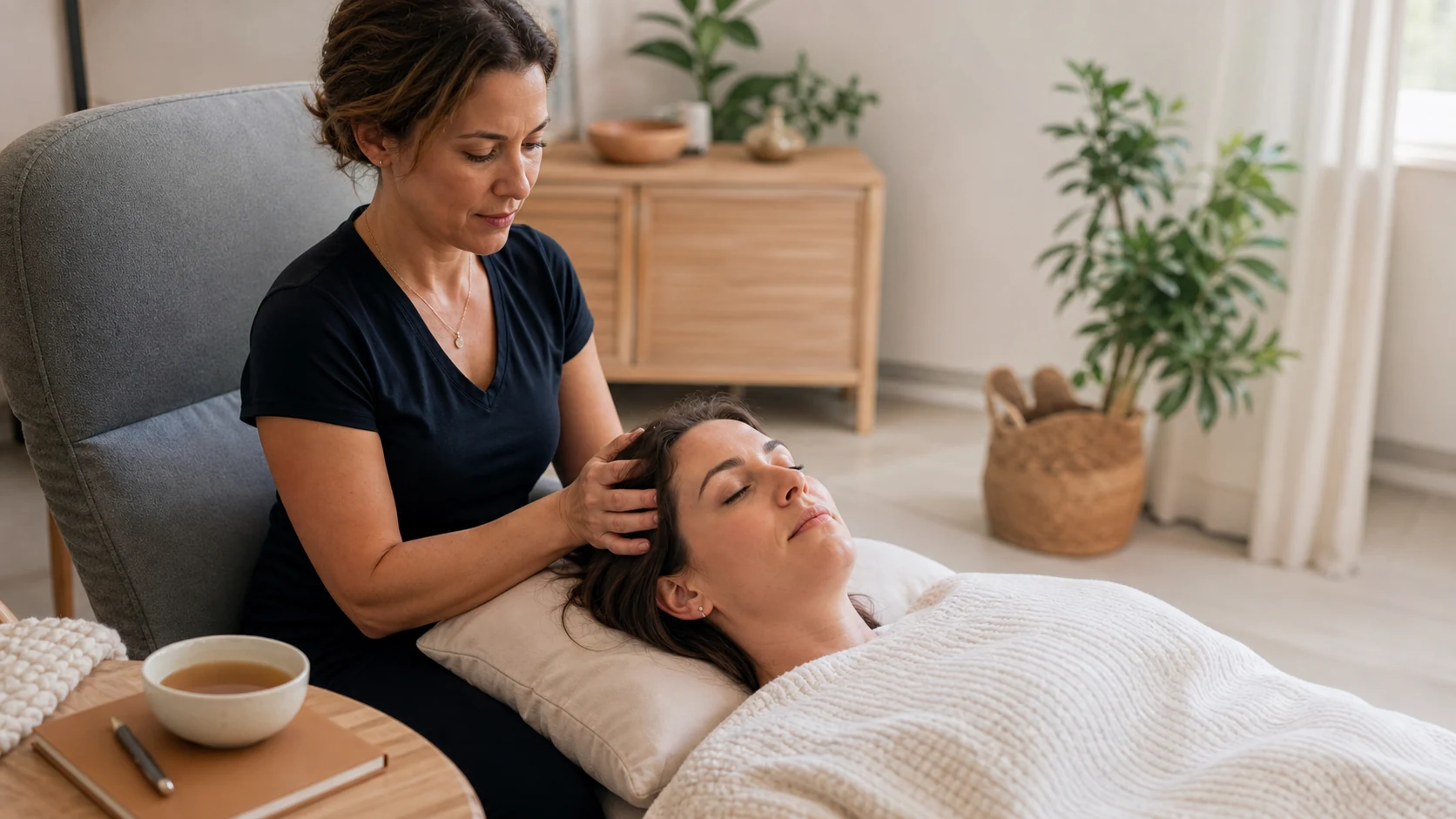
Menopause and Access Bars
Can Access Bars help with menopause symptoms?
Menopause is the natural transition when a woman stops menstruating. It is accompanied by hormonal changes that can cause symptoms like hot flashes, sleep disturbances, mood swings, stress, and weight gain.
Access Bars is sometimes promoted as a support for menopause symptoms. Practitioners claim it can reduce stress, improve sleep, and balance energy, which may help with symptom management [citation:9]. Some wellness centers offer Access Bars as part of menopause support programs.
Some people report feeling more relaxed, sleeping better, and having less stress during menopause after Access Bars sessions [citation:9].
These reports are anecdotal. There is no evidence that Access Bars treats menopause symptoms directly. It may provide relaxation, which can be helpful, but it should not replace medical care for menopause.
Menopause care: Access Bars as complementary support
A diagram showing Access Bars as a complementary practice alongside medical menopause care.
Medical menopause care
Hormone therapy, medication, and professional medical support.
Access Bars
Optional complementary relaxation practice.
Menopause symptom management
A combination of medical care and lifestyle support.
Skim first
Key takeaways
The shortest useful version of this page.
Access Bars is not a treatment for menopause symptoms.
Some women use it for relaxation during menopause [citation:9].
There is no evidence that Access Bars affects hormones.
Medical care for menopause should be the priority.
Access Bars may be used as optional relaxation.
Access Bars and menopause
- Access Bars developed as a general wellness practice.It wasn't designed for menopause.
- Some practitioners began offering Access Bars for menopause support.It was promoted for symptom relief.
- Access Bars is sometimes offered as a menopause support practice [citation:9].It is one of many complementary practices women try.
Menopause basics
What is menopause and how is it managed?
Menopause is the natural transition when a woman's menstrual cycles end, typically in her 40s or 50s. It is caused by declining hormone levels, particularly estrogen.
Common symptoms include hot flashes, night sweats, sleep disturbances, mood swings, anxiety, stress, weight gain, and changes in libido.
Management may include hormone replacement therapy (HRT), medication, lifestyle changes (exercise, diet), and complementary practices like relaxation and stress management.
The Access Bars explanation
How does Access Bars claim to help with menopause?
Within Access Consciousness, menopause symptoms are sometimes described as being related to stress, emotional blocks, or energetic imbalances. Practitioners claim that touching the 32 Bars points can release these blocks, promoting relaxation and balance [citation:9].
Some practitioners offer Access Bars specifically for perimenopause and menopause, claiming it can help with hot flashes, mood swings, and sleep issues [citation:9].
This explanation is part of the Access Consciousness framework. There is no evidence that menopause symptoms are caused by blocks in head points or that touching them releases anything.
A simpler explanation is that Access Bars provides deep relaxation and stress reduction, which can help with some menopause symptoms like mood and sleep.
What do practitioners and participants say?
- Practitioner
Some practitioners offer Access Bars for menopause support. They describe it as a way to reduce stress, improve sleep, and balance energy [citation:9].
- Participant
Some women report feeling more relaxed, sleeping better, and having fewer mood swings during menopause after Access Bars sessions [citation:9].
- Balanced view
These experiences are genuine but anecdotal. They do not prove that Access Bars treats menopause symptoms.
- Evidence view
There is no independent evidence that Access Bars affects menopause symptoms.
Access Bars should not replace medical care for menopause. It is not a treatment.
Evidence scan
What does the evidence say?
The evidence for Access Bars in menopause is limited to anecdotal reports [citation:9].
Overall: not enough evidence
Leans in favor
Points that support the claim
Stress reduction can help with menopause symptoms.
This is generally accepted. Access Bars may provide stress reduction.
Unclear or mixed
Not clearly for or against
Access Bars reduces hot flashes or night sweats.
There is no evidence. Some women may report improvement anecdotally [citation:9].
Leans against
Points that do not support the claim
Access Bars treats menopause symptoms.
There is no evidence to support this claim. Menopause symptoms require appropriate medical care.
Reality check
Common misunderstandings about Access Bars and menopause
- Myth
Access Bars can balance hormones.
RealityThere is no evidence. Hormone changes require medical care.
- Myth
Access Bars can cure menopause symptoms.
RealityMenopause is a natural transition. It is not a disease.
- Myth
Feeling better after Access Bars means it treats menopause.
RealityRelaxation can help, but it does not treat menopause.
- Myth
Access Bars is a safer alternative to HRT.
RealityIt is not a treatment. HRT is a medical decision with a doctor.
Safety
Is Access Bars safe during menopause?
The gentle touch procedure is generally safe, but it should not replace medical care.
Generally low-risk for
- Women seeking relaxation during menopause
- Those continuing their medical care
- Those who understand the limitations
Use caution if
- You are using Access Bars instead of medical care
- A practitioner promises menopause relief
Seek professional help if
- You have severe menopause symptoms
- You need medical evaluation or treatment for menopause
Access Bars is not a treatment for menopause symptoms. It should be used only alongside professional medical care.
What to remember about Access Bars and menopause
Access Bars is not a treatment for menopause symptoms.
Some women use it for relaxation during menopause [citation:9].
Stress reduction can support overall well-being.
There is no evidence that Access Bars affects hormones.
Medical care for menopause should be the priority.
Access Bars may be used as optional relaxation.
Verdict
Our verdict on Access Bars for menopause
insufficient-evidence
Access Bars is not an evidence-based treatment for menopause symptoms. It may provide relaxation, which can be valuable, but it should not replace medical care for menopause.
What we know
- Access Bars provides relaxation for some people.
- Stress reduction can support overall well-being.
- Menopause symptoms may require medical care.
What we do not know
- Whether Access Bars has any specific effect on menopause symptoms.
- Whether it affects hot flashes, sleep, or mood.
If you are going through menopause, prioritize medical care and evidence-based symptom management. Access Bars could be used as a relaxation tool, but do not rely on it for symptom relief.
Bottom line
Relaxation is helpful, but not a cure for menopause symptoms
Menopause is a natural transition, but its symptoms can be challenging. Access Bars might help you relax, but it is not a treatment. Your health deserves real medical care.
Quick answers
Frequently asked questions
Can Access Bars help with menopause?
There is no evidence. It may help with relaxation.
Does Access Bars reduce hot flashes?
There is no evidence. Some women report feeling better anecdotally [citation:9].
Is Access Bars a hormone treatment?
No. It does not affect hormones.
Should I try Access Bars for menopause?
If you want relaxation, it may be okay, but don't expect it to treat symptoms.
Is Access Bars safe during menopause?
It is generally safe as a relaxation practice, but don't replace medical care.
Sources
Access Consciousness. Access Consciousness Official Website - About Access Bars. Access Consciousness, REPLACE_IF_AVAILABLE. Accessed 2026-07-17
Use to establish official claims about Access Bars.
Treatwell. Treatwell - Access Bars for Menopause [citation:9]. Treatwell, REPLACE_IF_AVAILABLE. Accessed 2026-07-17
Use for information about Access Bars being offered for menopause support.
REPLACE WITH AUTHOR IF AVAILABLE. REPLACE WITH VERIFIED MENOPAUSE TREATMENT GUIDANCE. REPLACE WITH PUBLISHER, REPLACE_IF_AVAILABLE. Accessed 2026-07-17
Use for evidence-based information on menopause management.