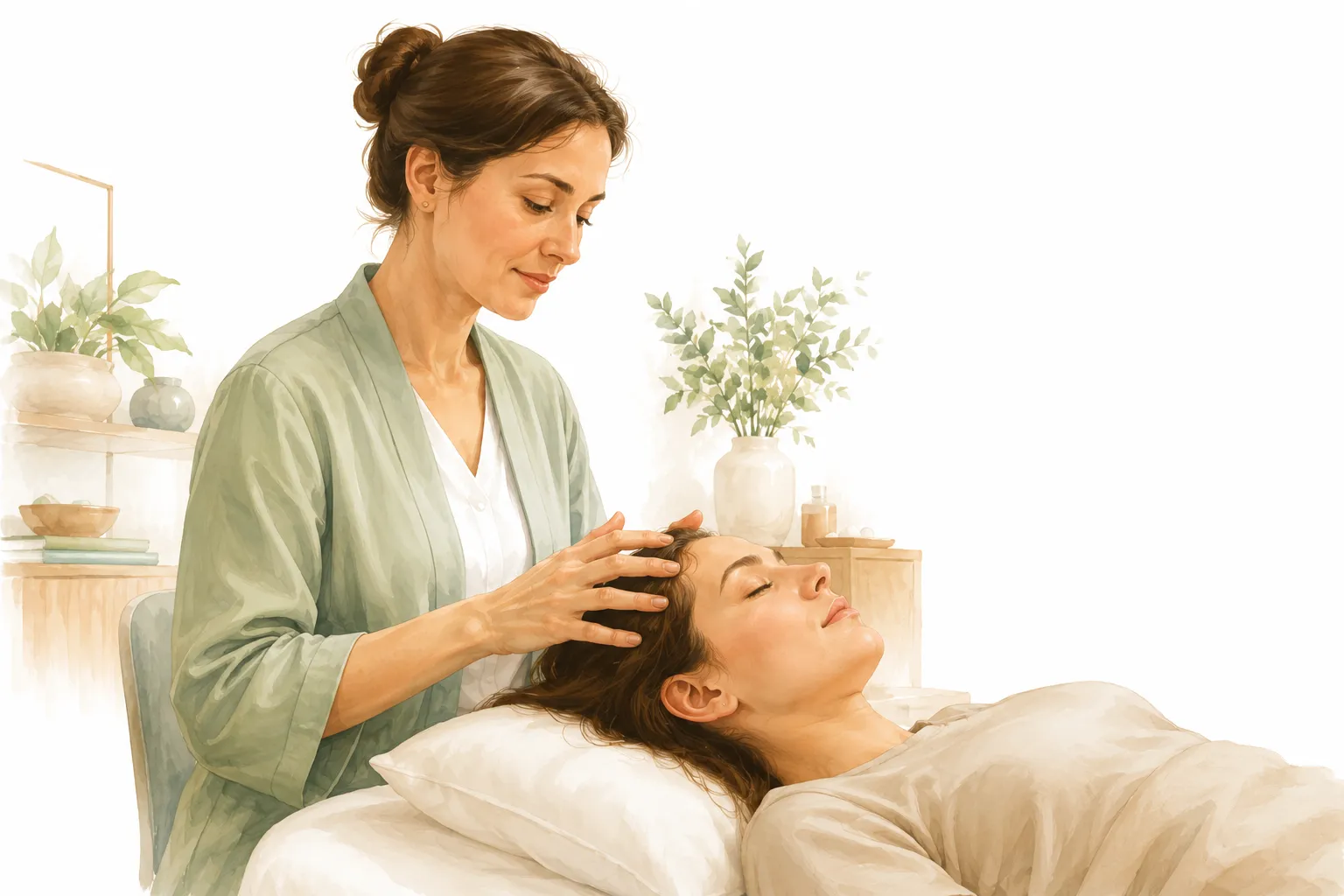
The core question
What Does 'Work' Actually Mean for Access Bars?
The question 'Does Access Bars work?' immediately runs into a definition problem. If 'work' means 'helps people feel relaxed and restful during a quiet session,' then for many people the answer appears to be yes. If 'work' means 'releases stored thoughts and beliefs from specific head points through a scientifically validated mechanism,' the evidence is far less clear.
Access Bars is a structured complementary wellness practice, not a medical procedure. Its official descriptions include claims about clearing mental patterns and emotions that practitioners say are stored in the head points. These claims are part of the Access Consciousness system's philosophy, but they require evidence to be considered scientifically established.
Several small studies have examined Access Bars, but they generally suffer from methodological limitations: small sample sizes, lack of control groups, reliance on self-reporting, and potential conflicts of interest. This does not mean the practice is worthless—it means its effects are not yet well understood through rigorous scientific methods.
A balanced approach considers three separate things: what participants report, what practitioners claim, and what independent research can actually demonstrate. Each belongs in its own category, and none should be confused with the others.
The Science Question in One Diagram
A neutral visual showing the gap between what Access Bars involves physically, what participants report, and what research has established.
Physical procedure
Light touch on designated head points, recipient fully clothed.
Participant experiences
Reports of relaxation, calmness, sleepiness, or no effect.
Scientific evidence
Limited high-quality studies; insufficient for broad therapeutic claims.
Skim first
Key takeaways
The shortest useful version of this page.
Access Bars can be subjectively relaxing for some participants.
The practice is not established as a treatment for medical or psychological conditions.
Anecdotal reports do not constitute scientific evidence.
The proposed mechanism of stored thoughts in head points is unproven.
Most research has significant methodological limitations.
A practice can be meaningful and helpful without being clinically proven.
Access Bars should complement, not replace, professional care.
How the evidence question developed
- Access Bars developed within Access Consciousness, promoted through workshops and practitioner training.The practice spread internationally through experiential learning and word-of-mouth rather than clinical trials.
- Increased public interest led to more questions about scientific backing and therapeutic claims.A gap emerged between participant testimonials and independent research.
- A small body of research exists, but significant methodological limitations remain.The question of effectiveness remains open, with strong opinions on both sides but limited definitive evidence.
Defining terms
What 'Works' Can Mean Very Different Things
If someone says Access Bars worked for them, they might mean it helped them relax, sleep better, feel calmer, or experience a shift in perspective. These are meaningful personal experiences that deserve respect.
But that is different from saying Access Bars works as a treatment for anxiety, depression, chronic pain, or other medical conditions. That kind of claim requires clinical evidence—controlled studies, measurable outcomes, and results that can be independently verified.
The gap between personal experience and clinical evidence is important. A person can genuinely feel better after a session without the session having produced a specific therapeutic effect beyond relaxation, attention, expectation, and the passage of time.
How Is Access Bars Supposed to Work?
Understanding the claimed mechanism is essential to evaluating whether it works.
The point system
Access Consciousness teaches that 32 points on the head correspond to different areas of life, such as money, control, creativity, and communication.
Within the system, these are described as 'Bars'—stores of accumulated thoughts and beliefs.Light touch
Practitioners gently hold combinations of these points during a session.
Release of stored patterns
The official claim is that touching the points helps release limiting thoughts, emotions, and decisions that have been stored in the head.
Supporters sometimes describe it as clearing mental 'clutter' or 'static.'Subjective effects
Participants often report relaxation, calmness, mental quiet, emotional lightness, or no obvious effect.
Scientific perspective
No established neurological or biological mechanism currently explains how storing or releasing specific thoughts at head points would work. The claimed mechanism is philosophical, not anatomical.
Evidence scan
What Does the Research Actually Show?
The scientific evidence for Access Bars is limited, but several studies and reviews have examined its effects. Here is what they found.
Overall: not enough evidence
Leans in favor
Points that support the claim
Access Bars may help reduce stress or anxiety.
Some small studies have reported reductions in self-rated stress or anxiety, but these studies often lack control groups and have small sample sizes. Results should be considered preliminary.
Unclear or mixed
Not clearly for or against
Participants report subjective improvements in well-being.
Qualitative reports often describe relaxation, calmness, or reduced mental chatter. These are subjective experiences that are not necessarily tied to a specific therapeutic mechanism.
Leans against
Points that do not support the claim
Touching Access Bars points releases stored thoughts or emotions.
No independent scientific research has confirmed this proposed mechanism. There is no established biological pathway for storing or releasing thoughts at head points.
Access Bars produces measurable therapeutic effects for health conditions.
The evidence base is insufficient to support broad clinical claims. Many studies have methodological limitations that prevent firm conclusions.
Reality check
Common Misunderstandings About Effectiveness
- Myth
If Access Bars didn't work, people wouldn't keep doing it.
RealityPeople continue practices for many reasons: belief, social connection, relaxation, hope, and tradition. Continued use does not prove a specific therapeutic mechanism.
- Myth
Feeling relaxed means the treatment worked.
RealityRelaxation is a genuine effect, but it is not evidence that the specific Access Bars mechanism—releasing stored thoughts from head points—is valid.
- Myth
There is no research on Access Bars.
RealitySome research exists, but much of it has significant limitations. The issue is not absence of research but quality and conclusiveness.
- Myth
Access Bars works for everyone.
RealityParticipant experiences vary widely, from profound relaxation to no noticeable effect. There is no evidence that it works universally or predictably.
Effectiveness Compared Across Categories
Understanding Access Bars requires comparing its reported effects across different types of outcomes.
Relaxation
Commonly reported
Likely, but non-specific
Quiet rest and gentle touch can promote relaxation
Mental clarity
Often reported
Unclear
May be related to relaxation and reduced distraction
Treatment for anxiety
Some participants
Insufficient evidence
Should not replace established treatment
Treatment for depression
Anecdotal
Insufficient evidence
Requires professional care
Physical health conditions
Anecdotal
Insufficient evidence
Not established as effective treatment
Mechanism (stored thoughts)
Claimed by practitioners
Not established
Remains a philosophical claim, not scientific
Different Views on Whether Access Bars Works
- Practitioner
Many practitioners report seeing positive changes in clients, including reduced stress, greater calm, and improved outlook. They often describe these effects as evidence that the Bars are 'clearing' stored patterns.
- Participant
Participant experiences range from deep relaxation and emotional release to feeling nothing unusual. Some return for regular sessions; others try it once and do not continue.
- Balanced view
Practitioners and participants can honestly observe positive subjective experiences without those experiences proving the specific mechanism claimed by Access Consciousness.
- Evidence view
Current independent research does not provide strong support for the specific therapeutic claims. However, subjectively positive experiences can be real and meaningful even when the proposed mechanism is unverified.
Positive experiences should not be misrepresented as proof of medical effectiveness, and Access Bars should never replace appropriate professional care.
What We Know and Don't Know
Access Bars is a gentle touch practice that many find relaxing.
Some participants report calmness, mental quiet, or emotional shifts.
These subjective experiences are not the same as proven therapeutic effects.
Independent research is limited and often methodologically weak.
The proposed mechanism is not scientifically established.
A practice can be meaningful and subjectively helpful without being clinically proven.
Access Bars should not replace medical or psychological care.
Verdict
Our Evidence-Based Verdict
insufficient-evidence
Access Bars 'works' for relaxation and subjective well-being for some people, but it is not established as an evidence-based treatment for any medical or psychological condition. The proposed mechanism—releasing stored thoughts from head points—remains scientifically unproven.
What we know
- The physical procedure is gentle and generally low in intensity.
- Some participants report relaxation, calmness, mental quiet, or emotional shifts.
- Quiet rest, gentle attention, and expectation can influence subjective experience.
- A small but limited body of research has been conducted.
What we do not know
- Whether Access Bars produces effects beyond ordinary relaxation and non-specific factors.
- Whether the proposed mechanism of stored thoughts in head points is valid.
- Whether the practice is an effective treatment for any medical or psychological condition.
- What the long-term effects of regular sessions might be.
Access Bars may offer a relaxing experience for those who are curious and have realistic expectations. It is not, however, a scientifically established treatment, and it should never delay or replace professional medical or psychological care.
Bottom line
The Honest Answer
The most honest answer to whether Access Bars works is that it depends on what you mean by 'works.' If you mean a relaxing, gentle practice that some people find helpful for calmness and mental quiet, then yes—it can work for some people. If you mean a proven treatment for health conditions or a scientifically validated mechanism for clearing stored thoughts, then no—the evidence does not yet support that conclusion.
Quick answers
Frequently asked questions
Does Access Bars actually work?
It may help some people relax and feel calmer, but it is not scientifically proven as a treatment for specific health conditions. The answer depends on what you mean by 'work.'
What does research say about Access Bars?
Available research is limited and methodologically weak. Some small studies report positive subjective effects, but the overall evidence is insufficient for broad therapeutic claims.
Is Access Bars scientifically proven?
No. There is no strong body of independent scientific evidence establishing Access Bars as an effective treatment for medical or psychological conditions.
Why do so many people believe Access Bars works?
Many people have positive subjective experiences, which are real and meaningful. Belief, expectation, relaxation, and placebo-like effects can all contribute to positive reports.
Can Access Bars help with depression?
There is insufficient evidence to support Access Bars as a treatment for depression. Depression is a serious condition that requires qualified professional care.
Sources
REPLACE WITH VERIFIED AUTHORS. REPLACE WITH VERIFIED ACCESS BARS RESEARCH PAPER. REPLACE WITH VERIFIED JOURNAL, REPLACE WITH VERIFIED DATE. Accessed YYYY-MM-DD
Use to assess the design, limitations, and findings of available Access Bars research.
REPLACE IF AVAILABLE. REPLACE WITH VERIFIED OFFICIAL ACCESS BARS DESCRIPTION. Access Consciousness, REPLACE IF AVAILABLE. Accessed YYYY-MM-DD
Use to establish how Access Consciousness describes its own method and claims.
REPLACE IF AVAILABLE. REPLACE WITH VERIFIED MEDICAL EVIDENCE GUIDANCE. REPLACE WITH RECOGNIZED MEDICAL SOURCE, REPLACE IF AVAILABLE. Accessed YYYY-MM-DD
Use for appropriate complementary-care, safety, and treatment-substitution context.