
Understanding the Access mantra
What the Access mantra is and how it's used
The Access mantra, more formally known as the Access Consciousness Clearing Statement, is a verbal statement used in Access Consciousness practices. It's meant to help practitioners and clients release limiting thoughts, patterns, or beliefs that may be holding them back.
The exact wording can vary, but a common version is: "All of the limitations, barriers, and judgments that I have created or accepted, I now choose to release and let go." This is often followed by a phrase such as "Right and wrong, good and bad, POD and POC, all of it, I now release."
The mantra is used in various ways: some practitioners say it silently or aloud during Access Bars sessions; others use it as a personal reflection tool; and it may be incorporated into Access Consciousness classes and workshops.
The philosophy behind the mantra aligns with Access Consciousness's emphasis on increasing awareness and expanding what's possible. The idea is that by verbally choosing to release limitations, a person can create a shift in consciousness. There is no scientific evidence that specifically verifies this mechanism.
Skim first
Key takeaways
The shortest useful version of this page.
The Access mantra is a verbal clearing statement used in Access Consciousness.
It's meant to help release limiting thoughts and patterns.
A common version is "All limitations, barriers, and judgments... I now choose to release."
Some people report feelings of release or clarity.
Scientific evidence for specific effects is lacking.
It should be approached as a reflective tool, not a guaranteed solution.
Professional care should be sought for persistent mental health concerns.
The statement
What is the Access mantra?
The Access mantra, also called the Access Consciousness Clearing Statement, is a spoken statement used in Access Consciousness. It's designed to help release thoughts, beliefs, and patterns that the practitioner or client may be holding onto.
The wording varies, but a common version is: "All of the limitations, barriers, and judgments that I have created or accepted, I now choose to release and let go." Some versions include additional elements such as: "Right and wrong, good and bad, POD and POC, all of it, I now release."
The mantra is not a traditional mantra in the sense of repetition for meditation or prayer. It's more of a clearing or intention-setting statement.
Some practitioners also use shorter versions or adapt the wording based on context or personal preference.
Access Mantra
Access Mantra
A verbal clearing statement used in Access Consciousness to help release limiting thoughts and patterns.
Used to create awareness, choice, and release. It's a tool for shifting consciousness and opening to new possibilities.
Spoken aloud or silently during Access Bars sessions, classes, or personal reflection.
While this is the official framework explanation, the effects are subjective and not scientifically verified. Verbal statements can influence mood and intention but don't necessarily have the specific effects claimed.
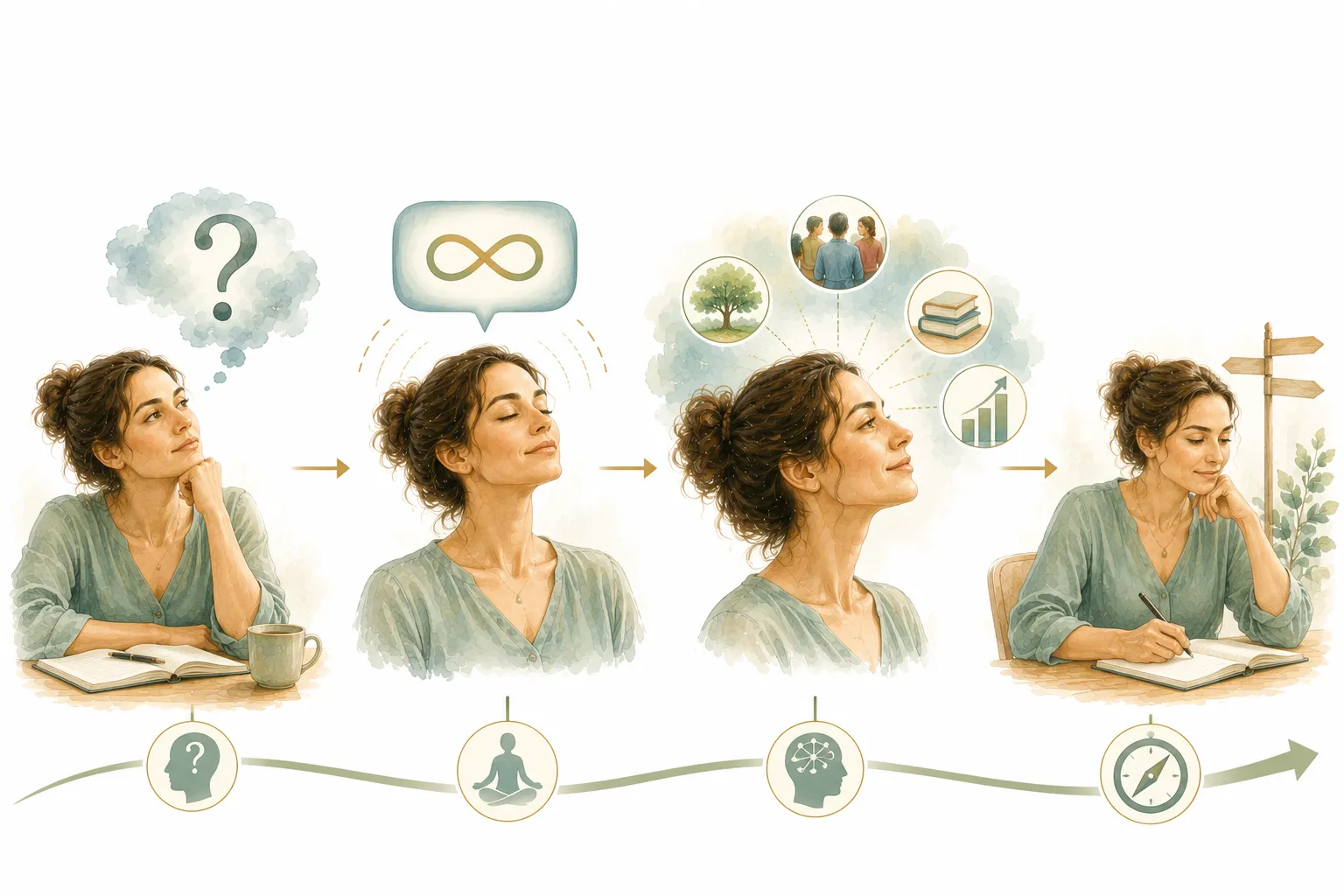
Think of what you want to release: a thought, pattern, or judgment.
Say the clearing statement aloud or silently.
Observe any feelings or shifts that occur.
Repeat as desired or needed.
How practitioners use the Access mantra
- Practitioner
Many practitioners see the mantra as a powerful tool for helping clients release limitations and open to new possibilities. They may use it during sessions to clear the way for the Bars work.
- Participant
Some participants report feeling lighter, more open, or more aware after hearing or using the mantra. Others feel little or nothing.
- Balanced view
These perspectives help explain why the mantra is used. However, personal reports don't establish a specific mechanism or prove the mantra's claims.
- Evidence view
Independent evidence is too limited to verify that the mantra has specific effects beyond relaxation, suggestion, or intention-setting.
Practitioners should avoid promising specific results or encouraging clients to use the mantra as a substitute for professional care.
Reality check
Common misunderstandings about the Access mantra
- Myth
The Access mantra is like a religious mantra or prayer.
RealityIt's a clearing statement used within Access Consciousness. It's not religious or spiritual in a traditional sense.
- Myth
The mantra has magical or supernatural effects.
RealityThere's no scientific evidence that the mantra has magical effects. It's a tool for intention-setting and reflection.
- Myth
Saying the mantra once is enough to release everything.
RealityThe mantra is meant to be used repeatedly as part of ongoing practice, not as a one-time solution.
- Myth
The mantra can replace therapy or medical treatment.
RealityNo. The mantra is a reflective tool, not a substitute for professional care.
Evidence scan
What does the evidence say about the Access mantra?
There's very little specific research on the Access mantra. Studies on mantras and affirmations generally focus on their effects on mood, intention, and self-perception.
Overall: not enough evidence
Unclear or mixed
Not clearly for or against
The Access mantra helps release limiting thoughts and patterns.
Anecdotal reports suggest some people find it helpful for intention-setting and reflection. These reports don't establish a specific mechanism.
Leans against
Points that do not support the claim
The Access mantra creates specific shifts in consciousness.
No established scientific evidence confirms this proposed mechanism.
The Access mantra has effects beyond general intention-setting.
Current evidence does not distinguish the mantra from other forms of verbal intention-setting.
What to remember about the Access mantra
It's a verbal clearing statement used in Access Consciousness.
It's meant to help release limiting thoughts and patterns.
A common version is "All limitations, barriers, and judgments... I now choose to release."
Some people report feelings of release or clarity.
Scientific evidence for specific effects is lacking.
It should be approached as a reflective tool, not a guaranteed solution.
It should not replace professional care for mental health concerns.
Verdict
Our evidence-based verdict
insufficient-evidence
The Access mantra is best understood as a verbal tool for intention-setting and reflection within Access Consciousness. While some people report positive experiences, there is insufficient evidence to support specific claims about its effectiveness.
What we know
- It's a verbal clearing statement used in Access Consciousness.
- It's meant to help release limiting thoughts and patterns.
- Some people report feelings of release or clarity.
What we do not know
- Whether the mantra has specific effects beyond intention-setting.
- Whether the mantra works through a distinct mechanism.
- Whether the mantra is more effective than other forms of reflection.
A person may choose to use the Access mantra as a reflective practice if they find it helpful. However, it should not be treated as a proven solution or replacement for professional care.
Bottom line
A reflective tool, not a proven solution
The Access mantra is a statement of intention used within Access Consciousness. Some people find it useful for reflection and release. Like many complementary practices, the subjective experience doesn't automatically prove the proposed mechanism.
Quick answers
Frequently asked questions
What is the Access mantra?
It's a verbal clearing statement used in Access Consciousness for releasing limiting thoughts and patterns.
What are the words of the Access mantra?
A common version: "All of the limitations, barriers, and judgments that I have created or accepted, I now choose to release and let go."
How do you use the Access mantra?
It's spoken aloud or silently during sessions, classes, or personal reflection.
Is the Access mantra effective?
Some people find it helpful for intention-setting and reflection. Scientific evidence for specific effects is lacking.
Is the Access mantra the same as an affirmation?
It's similar to an affirmation but with a specific focus on clearing and release within the Access Consciousness framework.
Sources
REPLACE IF AVAILABLE. REPLACE WITH VERIFIED OFFICIAL ACCESS CONSCIOUSNESS PAGE TITLE. Access Consciousness, REPLACE_IF_AVAILABLE. Accessed 2026-07-17
Use only to establish how Access Consciousness describes the mantra and its own claims.
REPLACE WITH VERIFIED AUTHORS. REPLACE WITH VERIFIED RESEARCH ON MANTRA AND AFFIRMATION EFFECTS. REPLACE WITH VERIFIED JOURNAL, REPLACE WITH VERIFIED DATE. Accessed 2026-07-17
Use for general research on mantras and affirmations.