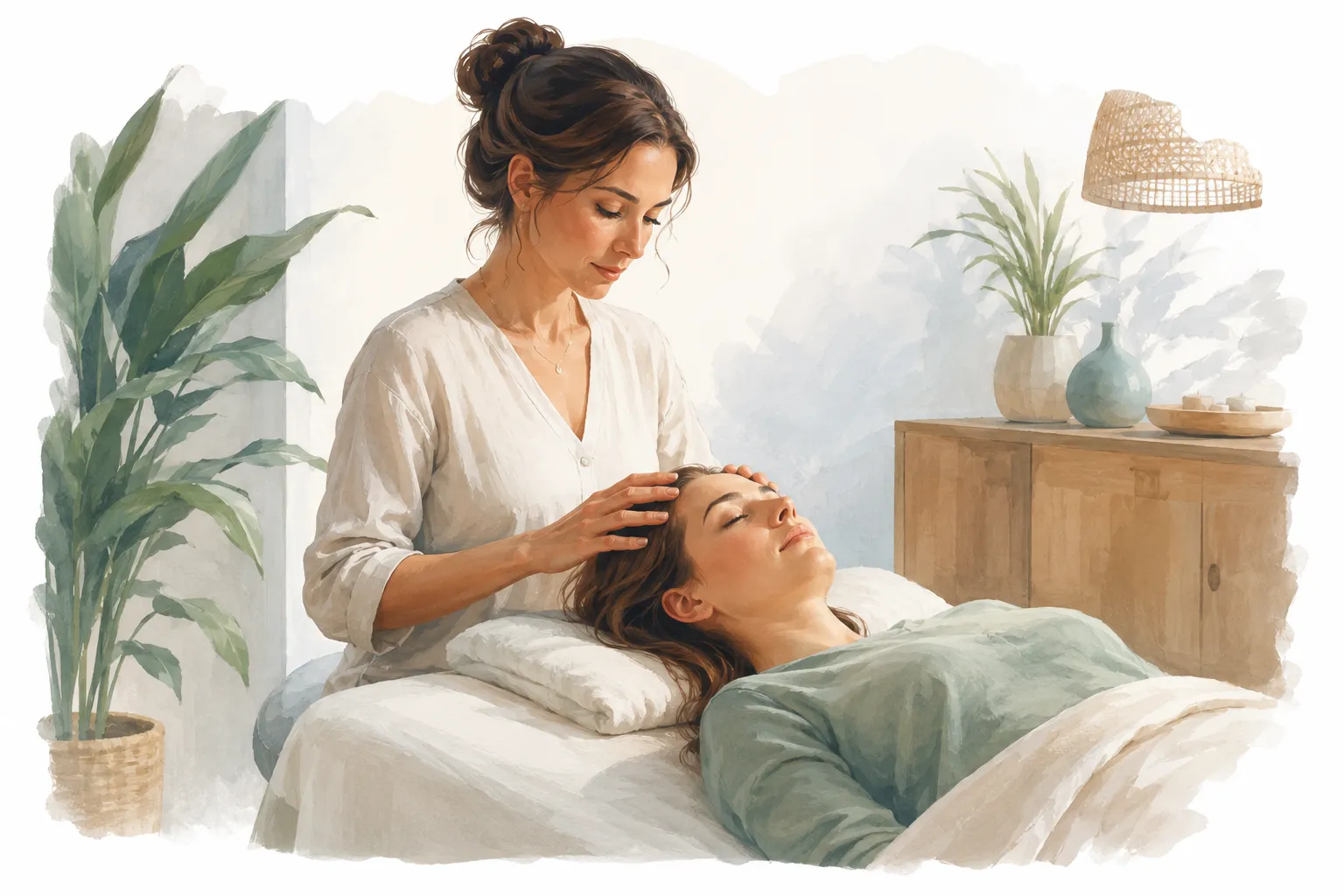
Beyond the touch
What safety really means for Access Bars
When people ask if Access Bars is safe, they are usually asking about physical safety. Does it hurt? Could it cause injury? The answer is generally no. The touch is light and gentle, and serious physical harm is extremely unlikely.
But safety is not only about physical injury. It is also about psychological safety, informed consent, realistic expectations, and the quality of the relationship with the practitioner. A session can be physically safe and still be harmful if it misleads, exploits, or delays necessary care.
This article examines both kinds of risk: what we know about the physical procedure, and what we know about the broader context in which Access Bars is offered.
Access Bars Safety Considerations
A visual overview of physical, psychological, and contextual safety factors.
Physical safety
Light touch on head points. Generally low-risk for healthy adults.
Psychological safety
Consent, boundaries, comfort, and emotional support.
Practitioner integrity
Training, ethics, transparency, and realistic claims.
Medical context
Complementary, not a substitute for professional healthcare.
Skim first
Key takeaways
The shortest useful version of this page.
Access Bars is generally safe for most healthy adults.
Physical side effects are mild and temporary: relaxation, drowsiness, occasional headache.
Psychological responses can include emotional shifts or sensitivity.
Serious risks are unlikely from the touch itself.
The main risk is delaying necessary medical or psychological care.
Practitioner ethics, boundaries, and transparency matter.
Consult a healthcare provider if you have concerns or specific health conditions.
Safety
Is Access Bars physically safe?
Access Bars uses gentle touch on the head. It does not involve manipulation, pressure, needles, or invasive procedures. For most people in good health, the physical risks are minimal.
Generally low-risk for
- Adults in generally good health
- People comfortable with gentle touch around the head
- Those seeking rest and relaxation
- Those who understand the session is complementary, not medical
Use caution if
- You have a recent head injury, concussion, or skull fracture
- You have open wounds, skin infections, or severe pain on the scalp
- You have uncontrolled epilepsy or a condition where touch triggers seizures or discomfort
- You are in an acute psychological crisis or severe ungrounded state
- You dislike or are distressed by touch around the head
- A practitioner makes medical claims or promises specific outcomes
Seek professional help if
- You have physical symptoms that need medical evaluation
- You are experiencing a mental-health emergency
- A practitioner suggests you discontinue prescribed medication or treatment
- You feel pressured, uncomfortable, or exploited during the session
Access Bars is a complementary wellness practice. It is not a substitute for diagnosis, treatment, or care from licensed medical or psychological professionals.
What to expect physically
Common physical side effects of Access Bars
The side effects of Access Bars are typically mild and short-lived. They are similar to what you might experience after any deeply restful or quiet experience.
The most commonly reported physical reactions include relaxation, drowsiness, sleepiness, and a sense of calm. Some people feel lightheaded or "spacey" for a short time afterward.
Less common but still reported: mild headache, slight nausea, fatigue, or muscle aches. These are usually temporary and resolve within a day.
Serious physical harm is extremely rare with Access Bars. The touch is not forceful enough to cause injury. However, if you experience severe pain, symptoms, or lasting discomfort, you should seek professional medical evaluation.
Emotional and psychological responses
Psychological side effects: what to know
Access Bars can sometimes evoke emotional responses. Some people feel deeply peaceful or emotionally open. Others may experience unexpected tears, mood shifts, or feelings of vulnerability.
For most people, these are transient and not cause for concern. They may be connected to rest, relaxation, or the release of mental or emotional tension. However, they are not a sign of a specific therapeutic process.
Psychological side effects can be more significant for people who are in a vulnerable state, have a history of trauma, or are prone to dissociation. In these cases, the relaxation and attention of the session may feel overwhelming or disorienting.
It is important to communicate any discomfort to the practitioner. Good practitioners will adjust their approach or stop the session if needed.
What practitioners say about safety
- Practitioner
Practitioners typically describe Access Bars as safe and gentle. They emphasize consent, comfort, and the non-invasive nature of the work. Good practitioners will also discuss contraindications and encourage clients to seek medical care when needed.
- Participant
Recipients commonly report feeling safe and cared for during sessions. Many describe a sense of trust and relaxation that makes the experience positive.
- Balanced view
Practitioners and participants may have positive experiences, but this does not establish that the practice is safe in a clinical sense. Safety also depends on ethical conduct, clear communication, and appropriate boundaries.
- Evidence view
There is limited independent research on Access Bars safety. Available evidence suggests low physical risk, but there is insufficient research on psychological safety, long-term effects, or practitioner training standards.
Do not assume that a practitioner's confidence or positive reputation is a substitute for professional medical oversight. Seek care from licensed professionals for health concerns.
Reality check
Common myths about Access Bars safety
- Myth
Access Bars is completely risk-free.
RealityNo wellness practice is risk-free for everyone. Psychological discomfort and delayed medical care are real risks.
- Myth
You can safely do Access Bars with any medical condition.
RealityCertain conditions—recent head injuries, unhealed wounds, severe mental-health crises—require caution or avoidance.
- Myth
If it feels good, it must be safe.
RealityPleasant experiences can coexist with unsafe practices or unrealistic expectations. Safety is about more than immediate comfort.
- Myth
Practitioners are healthcare providers.
RealityAccess Bars practitioners are not licensed healthcare providers unless they have separate clinical credentials.
- Myth
Access Bars can cure conditions.
RealityClaims of cure or treatment without evidence are misleading and potentially harmful.
Access Bars vs other wellness practices: safety comparison
Access Bars is often compared to other complementary and wellness practices. This comparison helps put its safety profile in context.
Access Bars
Very low (light touch)
Low to moderate (depends on practitioner)
Limited independent research
Massage
Low to moderate (pressure, muscle work)
Low (professional setting)
Good evidence for some benefits
Acupuncture
Low (needles, infection risk rare)
Low
Moderate evidence for some conditions
Reiki
Very low (light touch or no touch)
Low
Limited evidence
Psychotherapy
None
Low to moderate (emotionally challenging)
Strong evidence for many conditions
Evidence scan
What the evidence says about Access Bars safety
Research on Access Bars safety is limited. Most available information comes from practitioner reports and participant anecdotes rather than systematic studies.
Overall: not enough evidence
Leans in favor
Points that support the claim
Access Bars is physically safe for most healthy adults.
Available reports suggest low physical risk for the procedure. However, systematic safety research is lacking.
Unclear or mixed
Not clearly for or against
Access Bars has no psychological side effects.
Some participants report emotional responses. There is no systematic research on psychological safety.
Leans against
Points that do not support the claim
Access Bars can safely replace medical treatment.
This claim is not supported by evidence. Access Bars should not replace professional healthcare.
Safety key points
Physical risk is generally low.
Common side effects are mild: relaxation, drowsiness, occasional headache.
Psychological reactions can include emotional release or vulnerability.
Access Bars should not replace medical or psychological care.
Practitioner boundaries, consent, and transparency matter.
Regulation and practitioner qualifications vary widely.
If you feel uncomfortable or have health concerns, speak up or seek professional care.
Verdict
Our verdict on Access Bars safety
partially-supported
Access Bars is physically low-risk for most healthy adults. Its gentleness and non-invasiveness make serious harm unlikely. However, safety also depends on practitioner ethics, informed consent, realistic expectations, and the willingness to seek professional medical care when needed.
What we know
- The physical procedure is gentle and non-invasive.
- Common reactions are relaxation, drowsiness, and mild temporary symptoms.
- The practice is widely offered as complementary wellness.
What we do not know
- The full range of psychological safety considerations.
- Long-term effects or side-effect profiles.
- Safety for specific populations such as pregnant people or those with certain medical conditions.
Go ahead if you are in good health, comfortable with gentle head touch, and understand that Access Bars is not a substitute for medical or psychological care. If you have health concerns, check with a qualified professional first.
Bottom line
The true safety question
The question is not whether Access Bars is safe. It is whether it is safe in the context you are considering it. The physical touch is fine. The context—practitioner ethics, your health status, your expectations—is what matters most.
Quick answers
Frequently asked questions
Is Access Bars safe for everyone?
It is generally safe for healthy adults, but people with recent head injuries, unhealed wounds, or severe psychological distress should be cautious.
What are the side effects of Access Bars?
Common side effects are relaxation, sleepiness, and occasional mild headache. Emotional responses are also possible.
Can Access Bars cause anxiety?
For some, the relaxation and openness of the session might feel vulnerable or unsettling. If this happens, communicate with your practitioner.
Is Access Bars safe during pregnancy?
There is no specific safety research. Consult your healthcare provider before booking a session.
Can children do Access Bars?
Some practitioners offer sessions for children, but there is no established safety research. Parental discretion and consultation with a pediatrician are advised.
Sources
REPLACE IF AVAILABLE. REPLACE WITH VERIFIED OFFICIAL ACCESS BARS SAFETY GUIDANCE. Access Consciousness, REPLACE_IF_AVAILABLE. Accessed 2026-07-17
Official guidance on Access Bars safety and contraindications.
REPLACE WITH VERIFIED AUTHORS. REPLACE WITH VERIFIED RESEARCH ON COMPLEMENTARY PRACTICE SAFETY. REPLACE WITH VERIFIED JOURNAL, REPLACE_IF_AVAILABLE. Accessed 2026-07-17
Context on safety considerations for touch-based wellness practices.
REPLACE IF AVAILABLE. REPLACE WITH VERIFIED MEDICAL GUIDANCE ON COMPLEMENTARY THERAPIES. REPLACE WITH RECOGNIZED MEDICAL SOURCE, REPLACE_IF_AVAILABLE. Accessed 2026-07-17
General medical guidance on distinguishing complementary practices from clinical care.