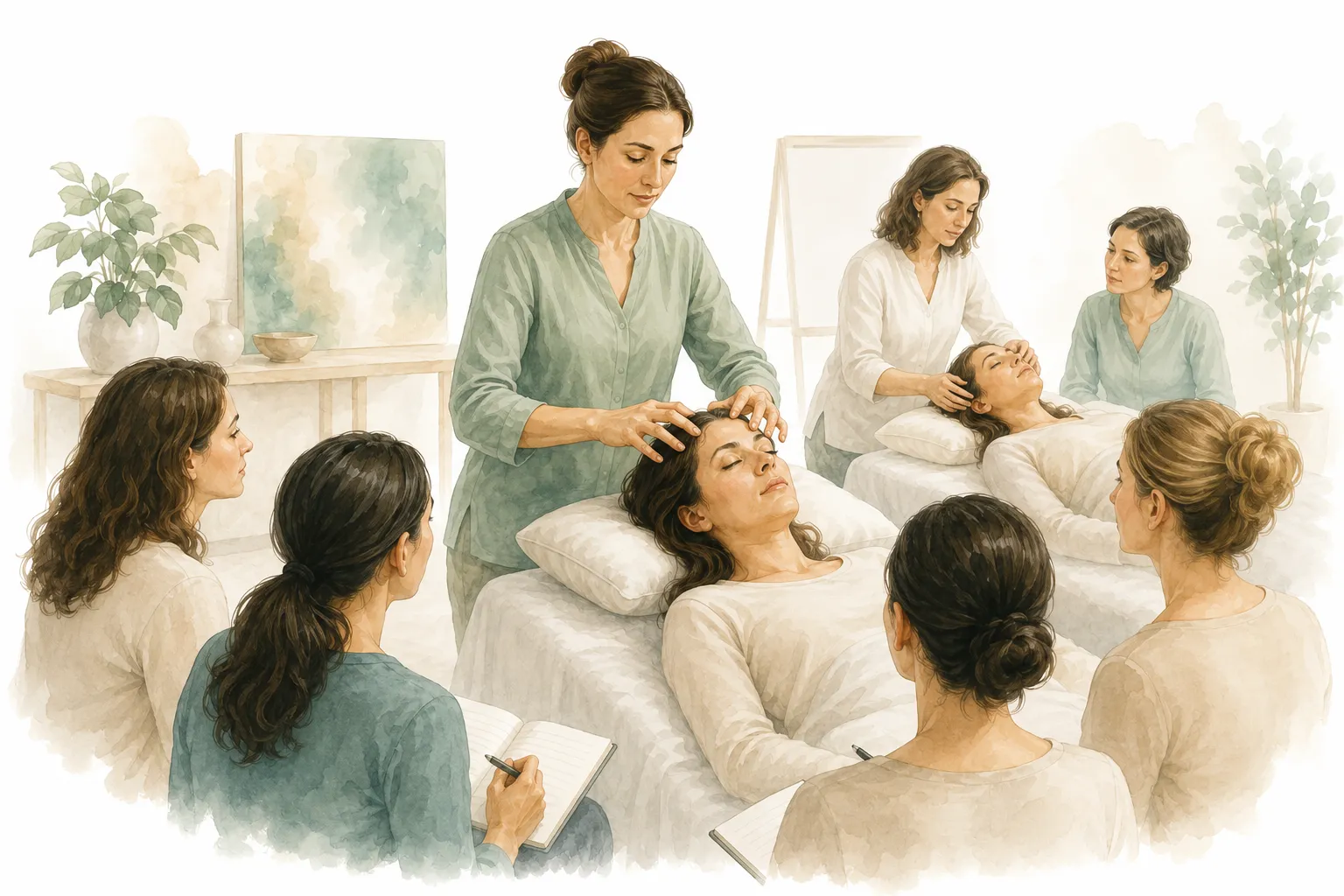
The class experience
What happens in an Access Bars class?
An Access Bars class is a one-day, in-person training program designed to teach you the Access Bars technique. The class is led by a certified Access Bars facilitator who guides participants through the theory and practice of the method.
The day is divided between instruction and hands-on practice. You learn the locations of the 32 points, the sequence for a complete session, and how to set up a comfortable environment. Then you practice giving and receiving Bars sessions with other participants.
Most classes run from about 9:30 AM to 5:30 PM, with a lunch break and shorter breaks throughout the day. The atmosphere is usually informal and supportive, with an emphasis on learning through doing.
No prior experience is required—anyone who is interested can attend. The class is suitable for both complete beginners and those who have some familiarity with the technique.
Skim first
Key takeaways
The shortest useful version of this page.
Access Bars classes are one-day, in-person training programs.
The class combines instruction and hands-on practice.
You learn the 32 points and session sequence.
You give and receive sessions during the class.
No prior experience is required.
Certification is provided upon completion.
The certificate is a training credential, not a clinical license.
The class fee is typically $200–$500 USD.
The training day
How the Access Bars class is structured
The Access Bars class is a full-day program. The exact schedule can vary, but a typical class runs from about 9:30 AM to 5:30 PM.
The morning usually focuses on instruction: the facilitator explains the Access Bars method, demonstrates the technique, and introduces the 32 points. Participants often learn the points through guided practice.
The afternoon is dedicated to hands-on practice. Participants pair up to give and receive Bars sessions under the facilitator's supervision. This practical component is the core of the class—by the end of the day, you've completed several sessions.
Throughout the day, the facilitator offers guidance, answers questions, and provides feedback. The atmosphere is collaborative and supportive.
What you'll learn in the class
The class covers both the theory and practice of Access Bars.
1. Introduction and overview
The facilitator explains what Access Bars is, its origins, and what the class will cover.
30–45 minutes2. Demonstration
The facilitator demonstrates the technique, showing how to locate points and the session sequence.
30–60 minutes3. Learning the points
Participants learn the 32 point locations through instruction, diagrams, and practice.
60–90 minutes4. Hands-on practice
Participants give and receive Bars sessions, supervised by the facilitator.
3–4 hours5. Review and questions
The facilitator reviews key points and answers any remaining questions.
30 minutes6. Certification
Participants receive a certificate of completion.
At the end of the class.
Access Bars class costs
The cost of an Access Bars class is the primary investment. Prices vary by location and facilitator.
| New participant class | $200–$500 | The standard cost for the one-day certification class. |
|---|---|---|
| Returning participant | $100–$250 | Discounted rate for practitioners retaking the class. |
| Travel and expenses | Participants cover their own travel, accommodation, and meals. | |
| Optional materials | Some facilitators offer additional materials for purchase. |
- Prices vary by country and region.
- Group discounts may be available.
- Payment is typically required at registration.
What participants say about the class experience
- Practitioner
Practitioners often describe the class as practical and accessible. They appreciate the balance of instruction and practice.
- Participant
Many students say the hands-on practice is the most valuable part of the class. It helps them remember the points and build confidence.
- Student
Students often find the class engaging and appreciate the facilitator's guidance. Some find the information overwhelming initially, but it becomes clearer with practice.
- Facilitator
Facilitators describe the class as an introduction to the technique and encourage students to continue practicing after the class.
- Balanced view
These perspectives describe the learning experience, not the validity of the technique itself.
- Evidence view
The class is a practical training program. It does not provide evidence for the technique's claims.
Certification is a training credential, not a clinical qualification. Practice responsibly.
Access Bars class vs. other wellness training
Comparing the class to other wellness trainings helps set expectations.
Duration
One day (8 hours)
Varies widely
Cost
$200–$500 USD
Varies widely
Prerequisites
None required
Often none
Format
In-person, hands-on
Can be in-person or online
Certification
Provided
Often provided
Clinical qualification
Not provided
Not typically
Reality check
Common misunderstandings about Access Bars classes
- Myth
The class is mostly theory and lecture.
RealityThe class is hands-on. A significant portion is dedicated to practical practice.
- Myth
You need experience to attend.
RealityNo prior experience is required. The class is designed for beginners.
- Myth
You become a therapist after the class.
RealityYou become a certified Access Bars practitioner. The class does not qualify you to practice clinical therapy.
- Myth
The class is expensive compared to other wellness training.
RealityThe cost is typical for a one-day wellness certification class.
- Myth
You learn everything about Access Consciousness in one day.
RealityThe class focuses on the Bars technique. Access Consciousness is a broader system with additional classes.
What to remember about Access Bars classes
The class is one day long (approximately 8 hours).
It's in-person and hands-on.
You learn the 32 points and session sequence.
You practice giving and receiving sessions.
No prior experience is required.
Certification is provided upon completion.
The certificate is a training credential, not a clinical license.
The class is typically $200–$500 USD.
Verdict
Our evidence-based verdict on Access Bars classes
insufficient-evidence
Access Bars classes are practical, accessible training programs that teach a specific technique. They are well-structured, hands-on, and open to everyone. However, the certification is a training credential, not a clinical qualification, and the technique's effects are not supported by strong independent evidence.
What we know
- The class is one day long and hands-on.
- No prior experience is required.
- Certification is provided upon completion.
- The class is offered globally.
What we do not know
- Whether the technique produces specific therapeutic effects.
- Whether the class prepares practitioners for clinical outcomes.
- Whether the technique works through the proposed mechanism.
Access Bars classes offer a practical way to learn the technique. Approach the training as learning a complementary wellness method, not as acquiring clinical qualifications.
Bottom line
Practical training, limited evidence
The class is practical, accessible, and enjoyable. The technique is learnable. The evidence for its effects remains limited.
Quick answers
Frequently asked questions
What is an Access Bars class like?
It's a practical, hands-on one-day training. You learn the technique, practice with other participants, and receive certification.
How do I find an Access Bars class near me?
Search for certified Access Bars facilitators in your area. Classes are offered globally through the Access Consciousness network.
Do I need a license to take an Access Bars class?
No license is required. The class is open to anyone.
Can I take an Access Bars class online?
The standard certification class is typically in-person to ensure supervised hands-on practice. Some facilitators may offer hybrid options.
What do I get after completing an Access Bars class?
You receive a certificate acknowledging your completion of Access Bars Practitioner training.
Sources
REPLACE IF AVAILABLE. REPLACE WITH VERIFIED OFFICIAL ACCESS BARS PAGE TITLE. Access Consciousness, REPLACE_IF_AVAILABLE. Accessed YYYY-MM-DD
Use to establish the official class structure and certification process.
REPLACE WITH VERIFIED AUTHORS. REPLACE WITH VERIFIED RESEARCH PAPER TITLE. REPLACE WITH VERIFIED JOURNAL, REPLACE WITH VERIFIED DATE. Accessed YYYY-MM-DD
Use to assess evidence for the technique.